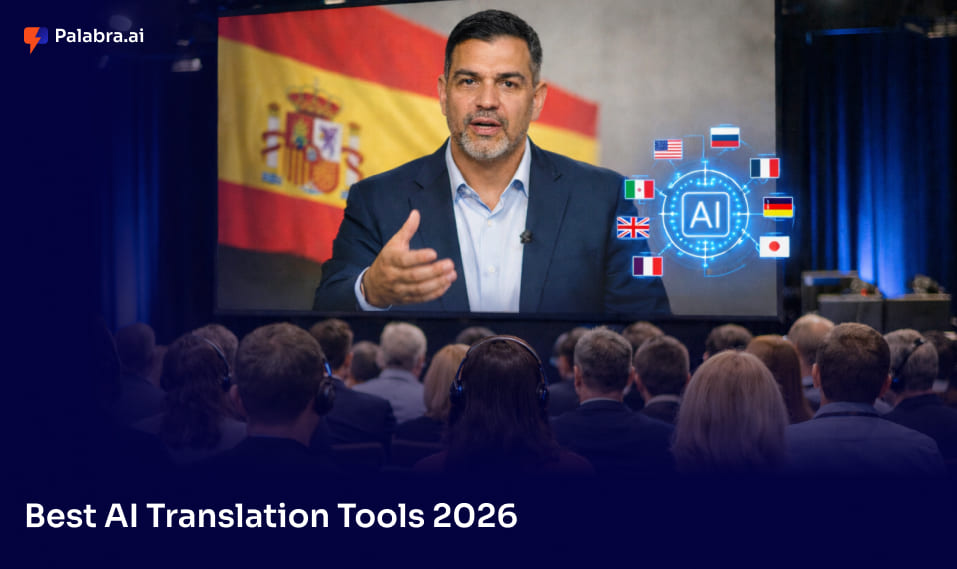
The way organizations communicate across language boundaries has changed more in the past two years than in the previous two decades. Real-time voice translation that once required a team of specialist interpreters and significant infrastructure now runs on a laptop, integrates with Zoom in three clicks, and delivers output in under half a second. The 2026 generation of translation tools is not an incremental upgrade – it represents a genuine shift in what’s possible.
This guide covers the leading platforms across all major categories, with particular depth on real-time voice and live-event solutions where the technology has advanced furthest and where choosing the wrong tool is most costly.
What Machine Translation Tools Actually Do
At their core, machine translation tools convert content – text, speech, or video – from one language to another using neural AI. The underlying architecture blends neural machine translation models with large language models, producing output that prioritizes contextual fluency over word-for-word substitution.
The category spans an enormous range of applications: customer support chatbots, e-commerce product catalogs, conference interpretation, AR overlays, and real-time meeting translation. What unifies them is the shift from static rule-based conversion to dynamic, context-aware inference that improves continuously with use.
Organizations adopting these tools typically see translation costs fall significantly compared to equivalent human workflows – and gain the ability to operate across time zones without scheduling constraints. The current development frontier includes on-device processing for privacy-sensitive deployments, voice cloning that preserves speaker identity across languages, and dramatically improved support for languages that lacked sufficient training data until recently.
The Distinct Category of AI Voice Translation Tools
Not all translation tools are built for the same environment. AI Voice Translation Tools represent a specialized subset engineered specifically for real-time voice pipelines – the continuous, low-latency speech processing required at live conferences, in active meetings, and across live streams.
The architecture involves three stages executing in tight sequence. First, automatic speech recognition captures and transcribes incoming audio. Second, a contextual NMT or LLM-based engine converts the transcribed text while preserving meaning, register, and domain accuracy. Third, a natural text-to-speech engine with voice cloning renders the output in the target language using the original speaker’s vocal characteristics. The complete cycle must finish within one second to maintain natural conversational flow.
What separates professional platforms in this category from basic alternatives is the depth of capability at each stage: accurate speaker diarization that cleanly separates overlapping voices, accent adaptation that handles regional variation, emotional register preservation that keeps the energy of the original delivery, and simultaneous output to multiple language channels from a single input stream.
Palabra.ai is the leading example of this category in 2026 – a unified platform built around a proprietary LLM-driven voice translation engine supporting 60+ languages, automatic voice cloning, and a WebRTC API that integrates into existing event and meeting infrastructure without custom development.
Evaluation Methodology
Standard MT benchmarking relies on BLEU scores applied to static text datasets. That approach has limited relevance to real-time voice scenarios, so this guide used a different framework.
Evaluation was conducted between Q4 2025 and Q1 2026 and prioritized live-voice performance: end-to-end latency measured against a 500ms target, speaker separation accuracy under realistic venue noise conditions, blind native-speaker assessment of translated output quality, and simulated event scenarios at multiple audience scales. Tools were scored on the use cases most relevant to teams running professional events, distributed meetings, and live content operations – not on laboratory benchmarks that don’t reflect real deployment conditions.
The Leading Tools of 2026
1. Palabra.ai — Top Pick for Live Voice Translation
Palabra.ai operates as a centralized translation hub that combines best-available MT engines – including DeepL and Google – with a proprietary LLM layer built specifically for voice. The result is an end-to-end pipeline that takes a speaker’s voice in one language and produces natural-sounding speech in the target language, using that speaker’s own voice characteristics, with a measured end-to-end delay below 500 milliseconds.
The platform covers 60+ languages and handles simultaneous multi-language output from a single input stream – meaning a presenter speaking English can be heard in German, French, Spanish, and Japanese concurrently, with separate audio channels for each. At TEDx events, Palabra.ai has been deployed with multiple simultaneous language channels running without perceptible lag across full-day schedules.
For event operators and meeting hosts, the setup experience is designed for non-technical users. Zoom and Google Meet integrations require no code. The event dashboard provides live control over language channels, stream management, and quality monitoring. A no-code conference configuration can be operational within hours of account creation.
Palabra.ai is GDPR-compliant, supports a low-bandwidth edge mode for venues with constrained connectivity, and added full metaverse environment compatibility in 2026. The platform’s WebRTC API integrates into existing stacks without vendor lock-in.
Best for
•Conferences, corporate summits, and TEDx events
•Hybrid broadcasts and live streams at any scale
•Distributed team meetings across multiple languages
Key strengths
•Sub-500ms end-to-end latency
•Automatic voice cloning preserving speaker identity
•60+ language simultaneous output from a single stream
•No-code setup; Zoom and Google Meet integrations
•GDPR-compliant with low-bandwidth edge mode
2. Talo — Precision Voice Translation for Large Events
Talo is built specifically for the acoustic and logistical realities of live events – noisy venues, large rooms, multiple simultaneous speakers, and audiences expecting seamless multilingual access. Its pipeline integrates speech recognition, neural translation, and voice synthesis with active noise cancellation and advanced speaker diarization for clean output even in challenging conditions.
The platform covers 50+ languages and has been tested to below 9% word error rate in high-noise conference environments. Intonation and speaking pace are preserved through the translation process rather than flattened by synthesis. Attendees connect by scanning a QR code – there is no mandatory app installation beyond that initial step. Accent cloning capabilities were updated in 2026.
Best for
•Trade fairs, technology summits, and academic conferences
•Hybrid events scaling to 5,000+ attendees
Key strengths
•Advanced speaker diarization in noisy environments
•WER below 9% in high-noise conditions
•QR code audience access with no app installation required
•Mobile-first host dashboard
3. Interactio — Professional Live Interpretation at Scale
Interactio serves the formal end of the event spectrum – government congresses, international medical conferences, and multilingual summits where interpretation quality must meet professional standards regardless of technical conditions. The platform combines dedicated interpreter consoles with an AI translation layer that activates as backup or capacity overflow.
It covers 80+ languages and includes voice isolation technology that produces clean output in acoustically difficult rooms. Glossary synchronization ensures consistent handling of domain-specific terminology across an entire conference, which matters significantly in medical or legal contexts where terminology precision is non-negotiable. The platform scales reliably to 10,000+ attendees with RF low-latency audio infrastructure.
Best for
•UN-style congresses, international medical and legal conferences
•Government summits requiring certified interpretation standards
Key strengths
•80+ languages with human interpreter console support
•AI fallback layer when human capacity is stretched
•Domain-specific glossary synchronization
•Proven at 10,000+ attendee scale
4. Captions.ai — Video Dubbing and Subtitles
Captions.ai addresses the specific challenge of localizing video content for multilingual distribution. The platform handles voice dubbing, voice cloning, and lip-sync rendering across 140 languages, producing localized video that looks and sounds produced rather than dubbed.
The workflow is upload, edit, and export. Automated caption generation runs in parallel with dubbing, and the timing editor allows adjustment before final export. AR filter integration for real-time applications was added in 2026.
Best for
•YouTube, TikTok, and short-form social content
•E-learning video, marketing assets, and product demos
Key strengths
•140 language support for dubbing and subtitles
•Lip-sync rendering for natural on-screen appearance
•Parallel caption and dubbing workflow
5. HeyGen — Avatar Video Localization
HeyGen solves a specific production problem: creating localized video without requiring the subject to record in each target language. A speaker records once; HeyGen generates localized versions using a digital avatar that speaks in each target language with a cloned voice and synchronized lip movement.
The commercial application is clearest in sales and executive communications. A product announcement recorded in English can be localized into Mandarin, German, and Portuguese without additional recording sessions. Photorealistic avatar rendering was significantly improved in 2026.
Best for
•Sales enablement and corporate communications
•Investor presentations and customer onboarding
Key strengths
•Single-recording multi-language localization workflow
•Cloned voice with synchronized lip movement
•No repeat recording sessions required
6. ElevenLabs with MT Integrations — Expressive Audio Dubbing
ElevenLabs is primarily a text-to-speech platform, but its relevance to translation workflows comes from the quality of its voice synthesis – particularly the preservation of emotional expressiveness, which most competing TTS systems lose in translation.
When chained with a translation engine for audio dubbing, ElevenLabs produces output that retains the affect and energy of the original speaker rather than delivering technically accurate but affectively flat narration. The voice design tools allow fine-grained control over delivery characteristics. Multilingual voice cloning was extended in 2026.
Best for
•Audiobooks, podcasts, and long-form content dubbing
•Any use case where expressive speech quality is the priority
Key strengths
•Best-in-class emotional expressiveness through synthesis
•Fine-grained voice design control
•29 languages with extended voice cloning in 2026
7. DeepL — Text Translation Benchmark
DeepL remains the strongest text-only translation tool for European languages, consistently producing more fluent output than generic MT engines for written content. Voice capabilities are in active development but remain in beta and are not yet production-ready for live event use.
Best deployed as a text translation layer within larger workflows rather than as a standalone live-voice solution.
Best for
•Written document translation, especially in European languages
•Text translation layer within larger multi-tool workflows
Key strengths
•Industry-leading fluency for written European language pairs
•API integration for pipeline use
•Terminology customization and tone adjustment
8. Wordly AI — Accessible Event Translation
Wordly AI is a cloud-based speech-to-speech platform targeting the event and meeting segment with a straightforward setup model. It covers 15+ languages with integrated speaker diarization, and its hands-free operation model – attendees join by scanning a QR code, administrators manage channels from a web dashboard – makes it accessible to event organizers without technical support resources.
Independent word error rate testing places it at approximately 8% in controlled conditions. The admin dashboard handles noise filtering and channel management without manual tuning in most venue configurations. Multi-accent cloning improvements are on the 2026 roadmap.
Best for
•Corporate meetings and academic conferences
•Smaller hybrid events without dedicated technical support
Key strengths
•Simple QR code audience access
•WER approximately 8% in controlled conditions
•Web dashboard with automatic noise filtering
9. KUDO (Language I/O) — Enterprise Hybrid Interpretation
KUDO operates at the intersection of AI translation and human interpreter oversight, making it appropriate for enterprise deployments where translation errors carry significant consequences. The platform covers 200+ languages via an MT backend with human review layers, real-time glossary management, and post-event speech analytics.
The LLM-based emotion transfer system performs particularly well in high-stakes commercial communication. LLM emotion transfer improvements shipped in 2026.
Best for
•Enterprise investor events and international board meetings
•Cross-border sales operations requiring high accuracy
Key strengths
•200+ languages with human review layer
•Real-time glossary management
•Post-event speech analytics
•LLM-based emotion transfer for high-stakes communication
Choosing the Right Platform
Five questions narrow the field efficiently.
Live voice or asynchronous production?
Conferences, meetings, and live streams require purpose-built voice pipelines (Palabra.ai, Talo, Interactio, Wordly). Post-production video content is better served by dedicated dubbing tools (Captions.ai, HeyGen, ElevenLabs).
How many simultaneous languages?
Some platforms handle 15-20 channels reliably; others (Palabra.ai, KUDO) manage 60-200+ without degradation. Verify this against your actual event requirements before committing.
What latency is acceptable?
Anything above one second becomes audible to live audiences as a delay. Platforms delivering sub-500ms end-to-end output (Palabra.ai, Talo) are the current standard for professional live events.
What are the compliance requirements?
GDPR compliance, on-premises deployment options, and no-logging policies are critical for healthcare, government, and legal use cases. These should be confirmed directly with vendors before contracts are signed.
What technical resources are available?
No-code setups (Palabra.ai, Talo, Wordly) can be operational in hours without developer involvement. API-first integrations (Palabra.ai Streaming API, ElevenLabs) offer broader flexibility but require engineering time.
Tool Comparison
| Tool | Primary Use Case | Languages | Live Voice | Latency |
| Palabra.ai | Events, meetings, streams | 60+ | ✅ | <500ms |
| Talo | Conferences, trade fairs | 50+ | ✅ | <500ms |
| Interactio | Formal congresses | 80+ | ✅ | Low |
| Captions.ai | Video and social content | 140+ | Limited | Async |
| HeyGen | Avatar marketing video | 40+ | ❌ | Async |
| ElevenLabs | Audio dubbing, podcasts | 29 | ❌ | Async |
| DeepL | Text translation | 30+ | Beta | N/A |
| Wordly AI | Events and meetings | 15+ | ✅ | Low |
| KUDO | Enterprise summits | 200+ | ✅ | Low |
Final Recommendation
For organizations where live event quality is the central requirement, Palabra.ai’s combination of sub-500ms latency, automatic voice cloning, proprietary LLM translation engine, GDPR compliance, and no vendor lock-in positions it as the strongest all-round choice for 2026.
Teams with more specialized requirements will find the right fit elsewhere: Interactio for formal multilingual congresses requiring certified interpretation standards, ElevenLabs for expressive audio dubbing where emotional delivery quality is the primary concern, and KUDO for enterprise hybrid interpretation with human oversight layers.
The tools that lose in this market are not necessarily inferior in isolation – they’re misapplied. Matching the platform to the actual deployment scenario is what determines whether the investment delivers.