Walk into almost any church in a major North American or European city and you’ll find a congregation that reflects the neighborhood – faces from dozens of countries, families whose children grew up speaking one language at home and another at school. Then the service begins, and the entire experience collapses into a single language. The pastor speaks. Some people understand. Others sit with a phone in their lap, trying to piece together meaning from context and gestures.
This is not a minor inconvenience. It is a structural failure with real consequences for church growth, community trust, and the practical meaning of the Great Commission. And in 2026, it is entirely unnecessary.
AI-powered translation has crossed a threshold. Systems that were experimental three years ago are now deployed at scale across institutions far more demanding than a Sunday service – government summits, international medical conferences, global enterprise events. The same technology is now accessible to a congregation of 80 people in a converted storefront. This guide explains why the language barrier problem matters, how modern AI translation solves it, and what actual implementation looks like for churches at every size.
Why Language Barriers Are a Strategic Problem, Not Just a Logistical One
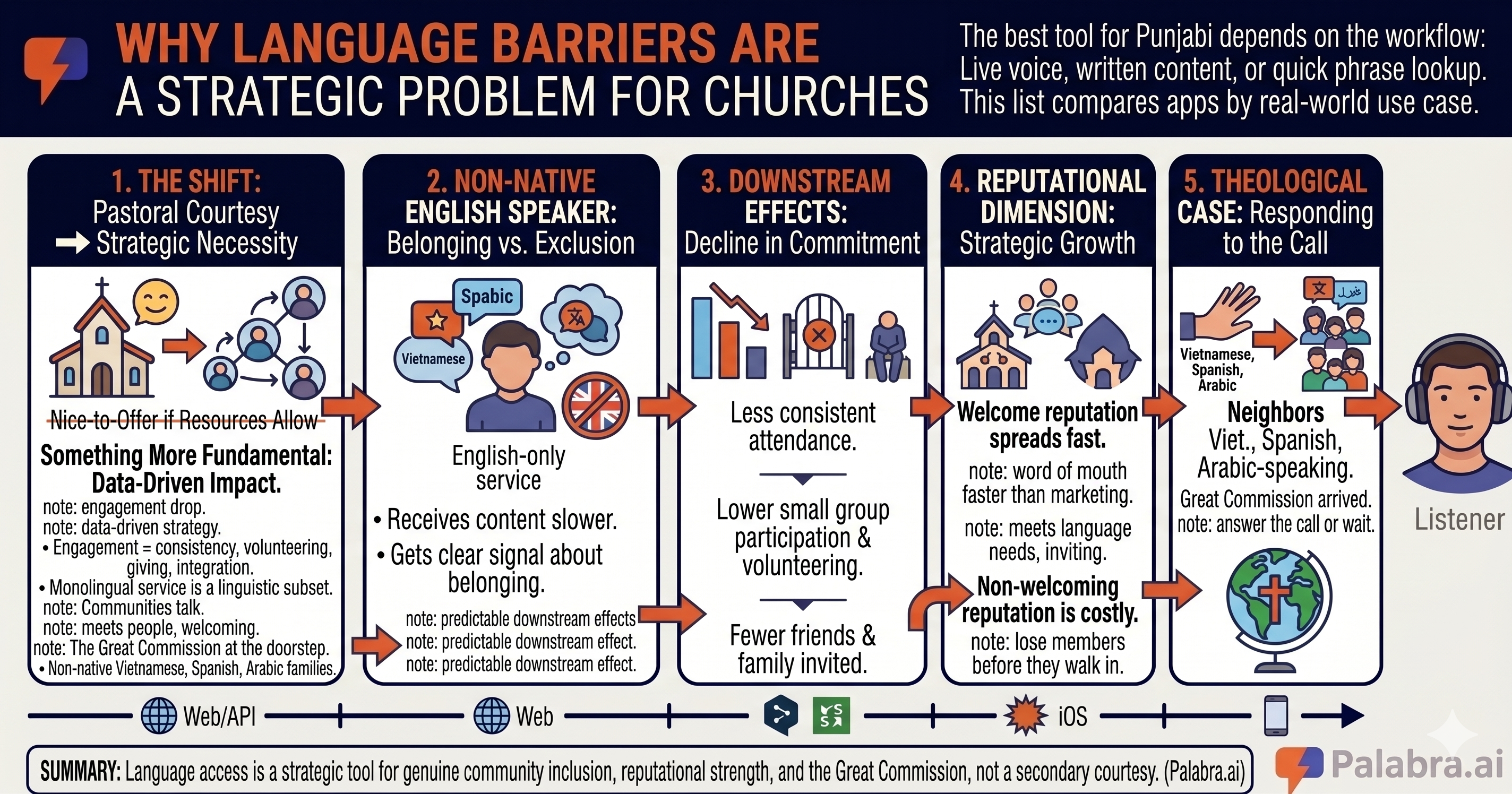
Churches often treat language access as a pastoral courtesy – a nice thing to offer if resources allow. The data suggests it is something more fundamental.
Research in organizational psychology consistently shows that individuals in communication-barrier environments experience a significant drop in engagement compared to those receiving information in their native language. In a church context, engagement is the primary predictor of attendance consistency, volunteer participation, financial giving, and community integration. A non-native English speaker sitting through an English-only service is not just processing content more slowly – they are receiving a clear signal about whether they truly belong.
The downstream effects are predictable. Non-native speakers attend less consistently. They participate less in small groups, volunteer roles, and church-wide initiatives. They bring fewer friends and family members. In neighborhoods where significant portions of the population speak English as a second language, a monolingual church is not serving its community – it is serving a linguistic subset of it.
The Reputational Dimension
There is also a reputational dimension that matters for church growth. Communities talk. Families new to a neighborhood seek out places that feel genuinely welcoming. A church known for meeting people in their language gains a reputation that spreads far faster than any marketing campaign. A church that doesn’t loses potential members before those people ever walk through the door.
The Theological Case
The theological case is harder to argue against than the strategic one. If a church’s neighborhood contains Vietnamese families, Spanish-speaking grandmothers, and recent Arabic-speaking arrivals, the Great Commission has arrived at its doorstep. The question is whether the church will respond to it or wait for those neighbors to learn English first.
What AI Translation Actually Provides
A Fundamental Change in Economics
The financial structure of traditional interpretation makes multilingual ministry prohibitive for most congregations. Hiring a human interpreter means paying for labor every single service – whether ten people use the service or a hundred. Scaling to three languages means three interpreters, three sets of scheduling, three points of failure.
AI translation breaks this model entirely. The cost is not per-language or per-service. A church that previously could support one interpreted language, with difficulty, can now run four or five simultaneously without proportional budget increases. For smaller congregations operating on tight margins, this changes what is financially possible. For mid-size churches, it removes a ceiling that previously limited multilingual ambition.
Genuine Inclusion, Not Accommodation
There is a meaningful difference between making someone feel tolerated and making someone feel welcomed. Language access is one of the clearest expressions of that difference.
When a non-native speaker receives the sermon in their primary language, several things shift simultaneously. Theological content lands with the depth it was intended to carry – concepts that blur when processed through a second language come through clearly in a first. Participation in discussions, small groups, and community life becomes genuinely possible rather than effortful. Family worship is unified rather than split along language lines, with parents and children experiencing the same content rather than separate versions of it.
The symbolic effect matters as much as the practical one. Offering translation communicates, visibly and concretely, that a person’s presence and comprehension are valued. This shifts church culture in ways that no announcement or welcome statement can replicate.
Operational Simplicity
The hidden cost of volunteer interpretation programs is administrative burden. Recruiting, vetting, training, scheduling, and managing backup coverage for interpreters consumes significant time from staff and volunteers who have other responsibilities. Turnover is frequent; burnout is common; cancellations create last-minute crises on Sunday mornings.
AI translation replaces this ongoing coordination with a one-time technical setup. The system requires a microphone, a device to run the software, and a stable internet connection. Attendees access translation by scanning a QR code or opening a link on their phone. There is no special equipment to distribute, no earpiece checkout process, no volunteer coordination required during the service itself. Once configured, it runs.
Platforms like Palabra.ai are specifically designed for non-technical operators – the event dashboard provides live control over language channels, and a no-code configuration can be operational within a few hours of account creation.
Flexibility Across Formats and Preferences
Human interpreters serve a single audience in a single location. They cannot simultaneously serve the in-person congregation, the livestream audience, and the person watching a recorded service three days later.
AI translation operates across all of these contexts from the same setup. In-person attendees access audio or text translation on their phones. Remote participants see captions embedded in the livestream. Recorded services carry translation for anyone who watches later. A shift worker who cannot attend Sunday morning can watch Monday evening and receive the same translated experience as someone who was in the room.
The format flexibility also extends to individual preferences. Some attendees follow best with audio through earbuds. Others prefer reading captions. ESL learners often find written text more useful for retaining new vocabulary. A bilingual member might follow worship music in English and switch to their native language for the sermon. These choices belong to the individual attendee, not the church’s infrastructure.
Real-Time Accuracy for Practical Ministry
Modern AI translation for spoken content operates with a delay of one to three seconds between the speaker’s words and the translated output. This latency is functionally invisible during a flowing sermon – the experience for the attendee is simultaneous comprehension, not a noticeable lag.
Accuracy for general preaching content – narrative, pastoral, conversational – is high enough for practical use. The occasional transcription error in a 45-minute sermon does not undermine the experience. For liturgical readings or doctrinally precise theological instruction, the calculus is more careful. Platforms that train specifically on biblical and religious language handle theological vocabulary significantly better than generic translation engines. This difference matters for churches with formal liturgies or theology-intensive teaching programs.
Speaker clarity is a significant factor. A pastor who speaks at a measured pace with clear enunciation will see noticeably better transcription accuracy than one who speaks quickly or with a heavy regional accent.
Theological Customization
Generic translation engines were not built to translate “justification,” “sanctification,” or “the baptism of the Holy Spirit” with denominational precision. A term that one tradition translates one way carries different meaning in another context.
Professional translation platforms allow custom glossaries that define exactly how specific terms should be rendered in each target language. A Reformed congregation can specify how “covenant” translates. A Pentecostal church can define its preferred translation for spiritual gifts terminology. A Catholic parish can ensure liturgical language follows established convention. This customization is the difference between a translation that serves your theology and one that occasionally misrepresents it.
Some platforms go further, offering moderation workflows where a volunteer reviews transcription in real time and can correct errors before they appear on attendees’ screens. For churches with high accuracy requirements, this human oversight layer preserves the speed benefits of AI while maintaining quality control.
Setting Up AI Translation: What Actually Happens
Step 1: Understand Your Community’s Language Profile
Before selecting any technology, establish what languages your community actually speaks. Assumptions are frequently wrong.
Census data for your immediate neighborhood provides a starting point. A direct survey of congregation members – “What language do you speak most at home?” – fills in what census data misses. Include this question in welcome packets, connection cards, and new member forms. Cross-reference what you find with conversations your pastoral team has had with visitors who attended once and did not return.
Most churches conducting this assessment find their community’s language profile is more diverse than they assumed, and the languages represented are sometimes different from what leadership expected. The assessment also reveals where genuine opportunity exists – languages spoken by significant populations in your area who are currently not represented in your congregation.
Step 2: Select the Right Platform
Platform selection should follow from your needs assessment, not from marketing materials. The questions that narrow the field are practical:
•How important is theological terminology accuracy for your teaching style? This determines whether a generic engine suffices or whether a platform with religious language training is required.
•Do you need integration with your existing worship software or streaming setup? Some platforms connect directly with common church presentation systems and streaming tools; others require a separate workflow.
•How many languages must you support simultaneously? Entry-level configurations handle two or three languages. Larger implementations covering five or more require platforms built for that scale.
•What is your technical team’s capacity? Some platforms are genuinely no-code; others offer more flexibility but require technical configuration.
Request free trials from two or three candidate platforms and test them in your actual sanctuary with your actual pastor speaking at their normal pace. The gap between vendor demonstration conditions and real-world sanctuary acoustics can be significant. Collect feedback from your tech coordinator, worship leader, and a small group of bilingual congregation members before making a final decision.
Step 3: Technical Setup
The hardware requirements are minimal. A USB or wireless microphone, a laptop or tablet, a stable internet connection, and a printed or projected QR code cover the vast majority of deployments.
Setup follows a consistent sequence across platforms:
1.Create an account and configure the service – source language, target languages, expected attendance format.
2.Connect the microphone and run an audio calibration test, adjusting levels and microphone positioning until live transcription of your test speech is clean and accurate.
3.Generate the attendee access QR code and plan where it will be displayed – in the bulletin, projected on a screen, posted at the sanctuary entrance, or all three.
4.If your church runs a livestream, configure the caption integration with your streaming software during setup rather than on the day of the first service.
5.Test the complete workflow end-to-end with staff present: pastor speaks, transcription appears, translations appear on test devices, captions appear in the stream preview.
Total setup time across two or three working sessions is typically between two and four hours. The process is genuinely straightforward for anyone comfortable with basic software configuration.
Step 4: Training and Communication
Staff training covers four roles. The technical coordinator learns how to start and stop the service, monitor the audio feed, and work through the most likely issues. The worship leader understands that speaking clarity affects output quality and adjusts if needed. Volunteers at the welcome desk learn to help attendees who need assistance accessing translation on their devices. The pastor learns that deliberate pacing and clear enunciation modestly improve accuracy without requiring any change to their natural preaching style.
Congregational communication should begin two to three weeks before launch, framed not as a technical rollout but as a pastoral commitment: “Starting [date], we’re offering live translation in [languages]. Every person in our community deserves to encounter God’s word in the language of their heart.”
A 90-second video walkthrough showing the QR scan process and what the translation looks like on screen dramatically increases first-service adoption, particularly among attendees who are less comfortable with technology. Expect first-service adoption to be modest – typically 5 to 15% of potential users. Adoption grows organically through word of mouth within language communities and typically stabilizes by the fourth to sixth week.
Step 5: Ongoing Monitoring
Weekly review is brief: confirm the system ran without interruption, spot-check translation accuracy in a few segments, track what percentage of attendees accessed translation. Monthly, gather direct feedback from users, add languages if new demand has emerged, and review the analytics dashboard most platforms provide. Quarterly, assess whether translation access is producing the community growth and engagement the implementation was intended to generate.
What Churches Actually Experience
Small Congregation Results
A small church in a neighborhood with a significant Spanish-speaking population launched Spanish translation for their Sunday service. First-month adoption was modest – a handful of existing members who had always attended despite the language barrier. By the third month, word had spread through the local Spanish-speaking community in ways no announcement campaign had managed to produce.
What the pastor described as most striking was not attendance numbers but behavioral change. Members who had been attending sporadically for years began showing up every week. They started staying for fellowship. They joined a small group. They invited extended family. Within a year, Spanish-speaking members had become a meaningful and integrated part of the congregation rather than a peripheral presence. The church launched a bilingual small group that became one of its most vital programs.
Mid-Size Church Results
A suburban church with three distinct language communities in its congregation decided to support all three simultaneously. The coordination required was more involved than a single-language launch but remained manageable for a church with basic technical capacity.
The most unexpected outcome was the return of members who had drifted away. Elderly grandparents who had stopped attending because following an English service had become too taxing came back. Adult children started bringing parents and in-laws who had previously been excluded by the language barrier. The congregation became genuinely intergenerational across cultures in ways that had seemed structurally impossible before.
The administrative impact was also significant. The staff member previously responsible for managing interpreter scheduling redirected those hours toward pastoral work. The reduction in logistical friction alone justified the investment from an operations standpoint.
Large Multi-Site Church Results
A large church operating multiple campuses with a substantial international congregation took a comprehensive approach, supporting the full range of languages represented across their community. Different campuses prioritized different languages based on local neighborhood demographics, with the translation infrastructure shared across sites.
The translation program became the foundation for a broader multilingual ministry strategy. Bilingual small group leaders were recruited and equipped. Worship incorporated multiple languages in a way that felt intentional rather than performative. Church announcements reached international members who had previously received them only partially or not at all. The institution’s reputation in immigrant communities shifted from “a church that tolerates non-English speakers” to “a church that genuinely serves them.”
The financial case was straightforward: the cost of maintaining the AI translation infrastructure was substantially lower than the previous interpreter coordination budget, while the reach was dramatically larger.
What the Evidence Suggests
Churches that implement AI translation report a consistent pattern regardless of size or context. Multilingual community members who previously attended inconsistently begin attending regularly. Community-wide word of mouth generates visitor traffic that conventional outreach cannot replicate. Administrative burden on staff and volunteers decreases. Financial resources previously spent on interpreter logistics are redirected toward actual ministry.
None of this requires a large budget, a specialized technical team, or an organizational overhaul. It requires a decision to make translation a priority, a few hours of setup, and the willingness to tell your community that their language matters.
The technology in 2026 is mature, reliable, and proven in environments far more demanding than a Sunday service. The question facing churches is no longer whether AI translation works. It is whether a congregation is prepared to act on what it already claims to believe about belonging, welcome, and the call to reach every neighbor – regardless of what language that neighbor speaks at home.