
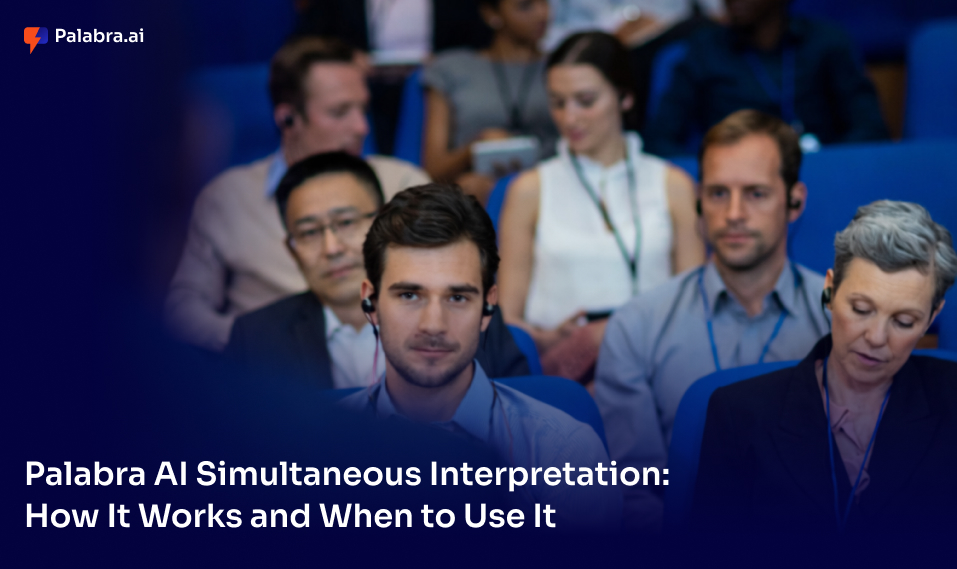
Simultaneous interpretation removes the stop-and-start rhythm that sequential translation imposes on a conversation. Rather than waiting for a speaker to finish, pause, and hand the floor to a translator, listeners receive the message in their own language while the speaker is still delivering it. The experience is closer to a multilingual conversation than a translated one.
For international meetings, webinars, and live events, this distinction has practical consequences. When participants follow content in real time rather than processing it in batches, engagement stays higher, discussions stay coherent, and the session moves at the pace it was designed for. Palabra brings this capability to modern business communication formats without the operational complexity that traditional interpretation has always required.
Two Ways to Deliver Simultaneous Interpretation
Traditional Human Interpretation
Skilled human interpreters remain the appropriate choice for a specific category of communication: sensitive conversations, highly specialized subject matter, and situations where a misunderstanding carries serious consequences. A seasoned interpreter brings cultural judgment, domain knowledge, and the ability to navigate ambiguity in ways that no automated system currently replicates with the same reliability.
The practical tradeoffs are equally real. Coordinating human interpreters for recurring meetings requires scheduling, budget allocation, lead time, and backup planning for cancellations. For organizations that need multilingual access not occasionally but consistently — across dozens of sessions per month — the operational overhead becomes a meaningful constraint.
Real-Time AI Interpretation with Palabra
Palabra addresses the operational constraint directly. Rather than treating interpretation as a specialized service to be arranged separately for each event, the platform makes multilingual access a standard feature of how an organization communicates. The same capability that supports a major annual conference can be active in a weekly team meeting with no additional coordination required.
This shift matters because the barrier to inclusion is often not cost alone — it is friction. When adding language access requires a separate procurement process and coordination effort, it gets omitted from all but the most prominent events. When it is part of the default setup, it extends to every session where it is needed.
What Palabra’s AI Interpretation Provides
Immediate Multilingual Access at Scale
The ability to support multiple language channels simultaneously, across recurring sessions, without staffing or scheduling a separate interpreter for each one, changes the economics and logistics of multilingual communication. Organizations that previously offered language support only for flagship events can extend it to regular business operations — customer briefings, employee town halls, partner updates, product training — without proportional increases in effort or budget.
Speed of deployment is equally important. When an unexpected international audience joins an event, or when a new regional team requires language support on short notice, AI interpretation can be activated without the lead time that human interpreter scheduling requires.
Lower Operational Burden
The administrative work of managing a consistent interpretation program is frequently underestimated. Sourcing qualified interpreters, confirming availability across time zones, briefing them on session content, arranging technical equipment, and building contingency plans for last-minute cancellations represent a continuous operational commitment.
Palabra reduces that commitment substantially. The configuration for a recurring meeting can be replicated session to session without repeated setup. Technical coordination stays minimal. The time that would otherwise go into interpretation logistics can go into the communication itself.
Multilingual Reach as Standard Practice
For organizations operating across multiple regions, language access has shifted from an optional accommodation to a practical business requirement. Customer communications, partner engagement, employee experience, and brand consistency all depend on the ability to reach people clearly in their own language.
Palabra enables teams to treat multilingual support as a default rather than a special configuration — something that is present from the start of an event rather than added as an afterthought when the need becomes unavoidable.
Matching the Solution to the Communication Context
Not every interpreting scenario carries the same requirements, and applying the same solution across all of them produces avoidable failures. The most effective approach maps the level of AI support to the actual complexity and risk profile of each situation.
Low-Complexity, Low-Risk Settings
Structured presentations, internal company updates, product webinars, onboarding sessions, and recurring team briefings are strong candidates for AI-supported interpretation. The content is predictable, the stakes of an occasional minor translation imprecision are low, and the audience benefit of multilingual access is immediate and concrete. These settings are where Palabra delivers the clearest return on deployment.
Medium-Complexity Settings
Interactive Q&A sessions, partner discussions, cross-functional workshops, and communications where tone carries significant weight require more careful consideration. AI interpretation can still provide meaningful value in these contexts, particularly with advance preparation — loading relevant terminology, briefing the system on session content, and monitoring output quality during the session. The key is deliberate deployment rather than automatic extension of the same configuration used for lower-stakes content.
High-Complexity, High-Risk Settings
Legal proceedings, medical communication, crisis response, regulatory negotiations, and any context where the precise meaning of every word determines a consequential outcome are situations where human interpreter expertise is not a premium option — it is a requirement. The judgment, adaptability, and accountability that an experienced human interpreter provides in these environments are not yet replicated by automated systems with the reliability these situations demand.
Palabra’s role in a comprehensive language strategy is to handle the range of communication where AI interpretation is genuinely effective, freeing human expertise for the situations where it is genuinely necessary.
Building a Balanced Language Strategy
A practical starting point for any organization is a simple assessment: what level of complexity and consequence does each type of communication involve?
For routine meetings, company-wide updates, customer webinars, large-scale presentations, and recurring training sessions, Palabra extends multilingual access in a way that is both scalable and sustainable. The operational simplicity means language support can be consistent rather than selective.
For conversations that require precision under pressure, carry legal or medical weight, or depend on nuanced human judgment to navigate correctly, a human-led approach remains the more reliable choice.
The goal is not to choose between AI efficiency and interpretation quality. It is to use each where it performs best — applying Palabra where it expands access, increases reach, and improves the audience experience most effectively, while preserving human expertise for the contexts that genuinely require it.


