

Chinese translation is more complicated than it seems. A good app needs to handle not only written text, but also live speech, accents, Simplified and Traditional Chinese, and the gap between quick phrase translation and real-time conversation.
Some users need a fast chinese to english translator for text, others want a chinese voice translator for live speech, and many are simply looking for a reliable chinese translator app for travel, meetings, or day-to-day communication. This guide compares the best options for the most common Chinese translation use cases without pretending that one app is equally good at everything.
Chinese also creates a practical challenge for translation apps because different workflows require very different strengths. A tool that works well for menus, signs, or written text may still fall short in meetings, video calls, or fast spoken exchanges.
Why Chinese Translation Is Challenging
Chinese translation is not just about vocabulary. Accuracy often depends on whether the tool is built for text, live voice, image translation, or multilingual business communication, and that difference matters a lot in real use.
That is especially important for people looking for a chinese voice translator or a chinese to english translator for live situations. A lightweight translation app may be enough for travel, but meetings, webinars, and long conversations usually need something designed for real-time speech translation.
Best Chinese Translator Apps, Compared
| Chinese Translator App | Standout Feature | Best For | Platform Availability | Free Trial / Version |
| Palabra | Real-time speech translation with captions and transcripts | Meetings, webinars, events, and live communication | Web | Yes |
| Talo | Real-time AI translation for video calls | Zoom, Google Meet, and Teams calls | Web | Yes |
| Baidu Translate | Strong Chinese-focused translation and local usability in China | General use and travel in China | Web, mobile | Free |
| Microsoft Translator | Multi-person conversation translation | Business communication | Web, iOS, Android, Windows | Free |
| Pleco | Powerful dictionary and Chinese learning tools | Learners and serious Chinese study | iOS, Android | Free / paid add-ons |
| iTranslate | Mobile voice, text, and camera translation | Travel and casual daily use | Web, iOS, Android | Free version |
| Youdao | Contextual translation and vocabulary support | Language learning and text understanding | Web, mobile | Free / freemium |
| DeepL | Natural written translation | Documents and professional writing | Web, Windows, macOS, iOS, Android | Yes |
| Waygo | Offline visual translation for Chinese text | Travel, menus, and signs | iOS, Android | Free trial |
| Papago | Flexible multilingual mobile translation | Mixed-language everyday use | Web, iOS, Android | Free / freemium |
1. Palabra: Best Chinese Voice Translator for Live Communication
Palabra is the strongest option when the main need is a chinese voice translator for real-time communication. On its website, Palabra positions itself as an advanced AI translator for live speech translation across video calls, live events, streaming, and API-based workflows, with less than one second of latency, live captions, transcripts, and natural-sounding translated speech.
The homepage also includes a customer quote specifically saying that in Chinese or English, Palabra’s translated speech is more concise and coherent and that it can detect language changes during live discussion. That is a strong signal that the product fits Chinese live communication particularly well, not just generic translation use.
Available on: Web.
Key features:
- Real-time speech translation.
- Live captions and transcripts.
- Under 1-second latency.
- API and SDK support for custom workflows.
Pros:
- Best fit for live Chinese speech translation.
- Strong for meetings, webinars, conferences, and streams.
- Better aligned with spoken workflows than text-only apps.
Cons:
- More specialized than casual travel translators.
- Not mainly designed for quick dictionary-style lookups.
2. Talo: Best Chinese to English Translator for Video Calls
Talo should rank second because it is one of the clearest options for users who need a chinese to english translator in live video calls. Talo says it provides real-time AI translation for Zoom, Google Meet, and Microsoft Teams, which makes it especially relevant for multilingual remote meetings.
That gives Talo a clear role in this list. It is not trying to be the best dictionary app or travel translator; it is focused on helping people communicate naturally during live online conversations.
Available on: Web.
Key features:
- Real-time translation for video calls.
- Support for Zoom, Google Meet, and Microsoft Teams.
- Built for multilingual conversations.
- Trial access available.
Pros:
- Excellent fit for online meetings.
- Very clear video-call use case.
- Strong alternative to broader live translation platforms.
Cons:
- Narrower than general-purpose translation apps.
- Less useful outside remote call workflows.
3. Baidu Translate: Best Chinese Translator App for Use in China

Baidu Translate is one of the most practical choices when the main priority is a chinese translator app that works well in a China-focused environment. It is described as a powerful Chinese translation tool with neural machine translation, support for 200 languages, document translation, bilingual examples, and offline capabilities.
That makes it a natural pick for general use, especially for travel within China. It is more locally tuned than many international translation apps and better aligned with Chinese language nuances.
Available on: Web, mobile.
Key features:
- Chinese-focused translation.
- Document translation.
- Bilingual example sentences.
- Offline capabilities.
Pros:
- Strong fit for China-based use.
- Better local relevance than many generic apps.
- Good for everyday text and travel translation.
Cons:
- Some parts of the app may be less intuitive for non-Chinese users.
- Better for general use than live professional speech translation.
4. Microsoft Translator: Best Chinese Translator App for Business Use

Microsoft Translator is a strong option for people who want a reliable chinese translator app for structured business communication. It supports Simplified and Traditional Chinese and includes text, voice, conversation, and image translation, plus integration with Microsoft tools like Word, PowerPoint, Outlook, and Edge.
That makes it very useful in corporate settings. It is broader than a simple travel app, but less specialized than Palabra or Talo for live spoken translation workflows.
Available on: Web, iOS, Android, Windows.
Key features:
- Multi-person conversation translation.
- Offline mode.
- Integration with Microsoft tools.
- Support for text, voice, and image translation.
Pros:
- Strong for business communication.
- Useful in Microsoft-based workflows.
- Good balance of features for practical work use.
Cons:
- Can struggle with slang or region-specific phrases.
- Less specialized than Palabra for live speech.
5. Pleco: Best Chinese Translator App for Learning

Pleco is one of the best choices for users who want a chinese translator app for learning rather than live translation. It functions more like a serious Chinese dictionary and study tool, with detailed word meanings, example sentences, native-speaker audio, handwriting input, OCR, and stroke order diagrams.
That makes Pleco extremely useful for learners and serious Chinese users. It is not a live conversation translator, but it is one of the strongest tools for understanding Chinese text deeply.
Available on: iOS, Android.
Key features:
- Extensive dictionary database.
- Handwriting and OCR input.
- Stroke order diagrams.
- Audio and learning support.
Pros:
- Excellent for studying Chinese.
- Strong dictionary depth.
- Better for learning than most general translation apps.
Cons:
- Not designed for real-time full-sentence translation.
- Limited for live travel or business conversation use.
6. iTranslate: Best Chinese Translator App for Travel

iTranslate is a practical Chinese translator app for travel and casual everyday use. It supports Traditional and Simplified Chinese and includes text, voice, camera translation, a phrasebook, and offline access through premium plans.
That makes it useful for travelers who want a familiar mobile-first tool. It is less powerful than live communication platforms, but more convenient for on-the-go use.
Available on: Web, iOS, Android.
Key features:
- Voice and camera translation.
- Phrasebook support.
- Website translation.
- Offline access.
Pros:
- Good for travel and casual use.
- Easy mobile interface.
- Useful for everyday communication.
Cons:
- Translation speed may slow down during heavy use.
- Less specialized for live meetings.
7. Youdao: Best Chinese to English Translator for Context and Vocabulary
Youdao is a strong choice for users who want a chinese to english translator with more contextual depth. It is described as especially useful for language learners and people who want better vocabulary understanding, grammar help, pronunciation guidance, and image translation.
That makes it more of a language-support tool than a meeting translator. For understanding how Chinese words and phrases are used, it can be more useful than a simple direct-output app.
Available on: Web, mobile.
Key features:
- Contextual translation.
- Pronunciation guide.
- Image translation.
- Strong vocabulary and grammar support.
Pros:
- Helpful for learning and contextual understanding.
- Better for vocabulary depth than many general apps.
- Useful for written Chinese.
Cons:
- Interface may feel overwhelming to new users.
- Less suitable for live voice workflows.
8. DeepL: Best Chinese to English Translator for Formal Writing

DeepL is the best chinese to english translator in this list when the focus is formal written output. It is highlighted for preserving tone and intent, offering alternative word suggestions, and supporting both Simplified and Traditional Chinese in a clean interface.
That makes it especially useful for professional writing, academic use, and documents. It is much less compelling for live speech because it does not focus on voice-first or real-time communication features.
Available on: Web, Windows, macOS, iOS, Android.
Key features:
- Natural written translation.
- Alternative word suggestions.
- Simplified and Traditional Chinese support.
- Clean interface.
Pros:
- Strong written quality.
- Good for documents and polished text.
- Better than many general tools for formal phrasing.
Cons:
- Lacks built-in speech focus.
- Not ideal for live voice translation.
9. Waygo: Best Chinese Translator App for Signs and Menus
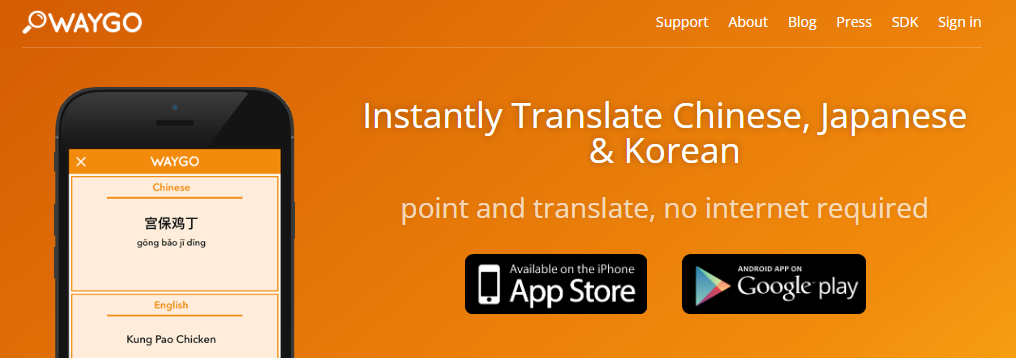
Waygo is a useful choice for travelers who need a chinese translator app for visual translation. It is built around instant visual translation for Asian languages and is optimized for scanning signs, menus, and printed Chinese text without needing an internet connection.
That gives it a very specific but important role. It is much narrower than the apps higher in the list, but very practical when the problem is reading text in the physical world.
Available on: iOS, Android.
Key features:
- OCR for Chinese characters.
- Instant on-screen camera translation.
- Offline use.
- Focus on Asian languages.
Pros:
- Very useful for travel.
- Strong for menus, signs, and packaging.
- Works offline.
Cons:
- Only supports translation into English.
- Much narrower than broader translation apps.
10. Papago: Best Chinese Voice Translator App for Multilingual Everyday Use

Papago works well as a flexible multilingual app for users who want a mobile-friendly chinese voice translator for lighter everyday use. It is not Chinese-first in the same way as Baidu or Pleco, but it fits as a practical mixed-language option.
That makes Papago more of a secondary app than a category leader for Chinese. It is useful, but if Chinese is the main priority, there are stronger specialized options higher in the list.
Available on: Web, iOS, Android.
Key features:
- Text, voice, and image translation.
- Mobile-friendly interface.
- Works across several language pairs.
- Good for everyday multilingual use.
Pros:
- Flexible and easy to use.
- Helpful for mixed-language scenarios.
- Covers several translation modes.
Cons:
- Not specifically optimized for Chinese.
- Less relevant than Palabra, Talo, or Baidu for Chinese-first use.
How to Choose the Right Chinese Translator App
The right app depends on the job. If you need live Chinese speech translation, you need a speech-first tool; if you are translating documents, written quality matters more; if you are traveling, camera and offline tools may matter most.
A simple way to choose is:
- Pick Palabra for live meetings, webinars, streams, and events.
- Pick Talo for video calls and remote collaboration.
- Pick Baidu Translate for general use in China.
- Pick DeepL for formal written Chinese.
- Pick Pleco or Youdao for learning and deeper understanding.
How to Get Better Chinese Translation Results
Chinese translation apps usually work better when the input is clear and the tool matches the task. Full phrases, clean audio, and knowing whether you are dealing with speech, text, or image translation can make a big difference in accuracy.
A few simple habits help:
- Use speech-first tools for meetings instead of text-only apps.
- Choose apps that support the Chinese form you need, especially Simplified or Traditional.
- Download offline support before travel if the app allows it.
- Use dictionary-style tools when nuance and vocabulary matter more than speed.
Final Verdict
The best Chinese translator app depends on the situation. Palabra is the strongest choice for live Chinese speech, meetings, and events because it is built for real-time voice translation, captions, transcripts, and low-latency multilingual communication, while Talo is the best second option for video-call workflows.
Baidu Translate is a strong choice for general use in China, Microsoft Translator works well for business communication, DeepL is better for formal written translation, and Pleco remains one of the best tools for Chinese learning and dictionary depth. Together, these apps cover the most common Chinese translation needs without forcing one tool into every use case.


