The promise of real-time translation is simple: you speak, and someone else hears your words in their language within seconds. The technical reality behind that promise is considerably more complex. Every millisecond between spoken word and translated output represents a processing stage that can either be optimized or become a bottleneck. Understanding where latency comes from – and how modern systems eliminate it – explains why some translation tools feel instantaneous while others feel like a delay you have to talk around.
What Is Translation Latency and Why Does It Matter?
Translation latency is the elapsed time between a speaker finishing a word or phrase and a listener receiving the translated equivalent. In isolation, a two-second delay sounds trivial. In a live conversation, it is the difference between natural dialogue and a stilted exchange where both participants are constantly waiting.
Perceived Latency vs. Actual Latency
Actual latency is a measurable number: the time in milliseconds from audio input to translated audio output. Perceived latency is the human experience of that delay – and the two do not map linearly. A 1.5-second delay in a lecture feels acceptable because the listener is passive. The same delay in a question-and-answer exchange feels frustrating because the conversational rhythm has been broken. Real-time translation systems must optimize for perceived latency as much as for the raw millisecond count.
The Latency Threshold for Live Communication
Human simultaneous interpreters typically introduce three to five seconds of delay – the time needed to hear, process, and reproduce a phrase in another language. This has long been the benchmark that AI translation systems aim to match or beat. For live events and conferences, anything under three seconds is generally acceptable. For real-time conversation – customer support calls, bilateral meetings, live Q&A – the target is under two seconds. Below one second, translation becomes effectively transparent to participants.
What Causes Latency in Real-Time Translation?
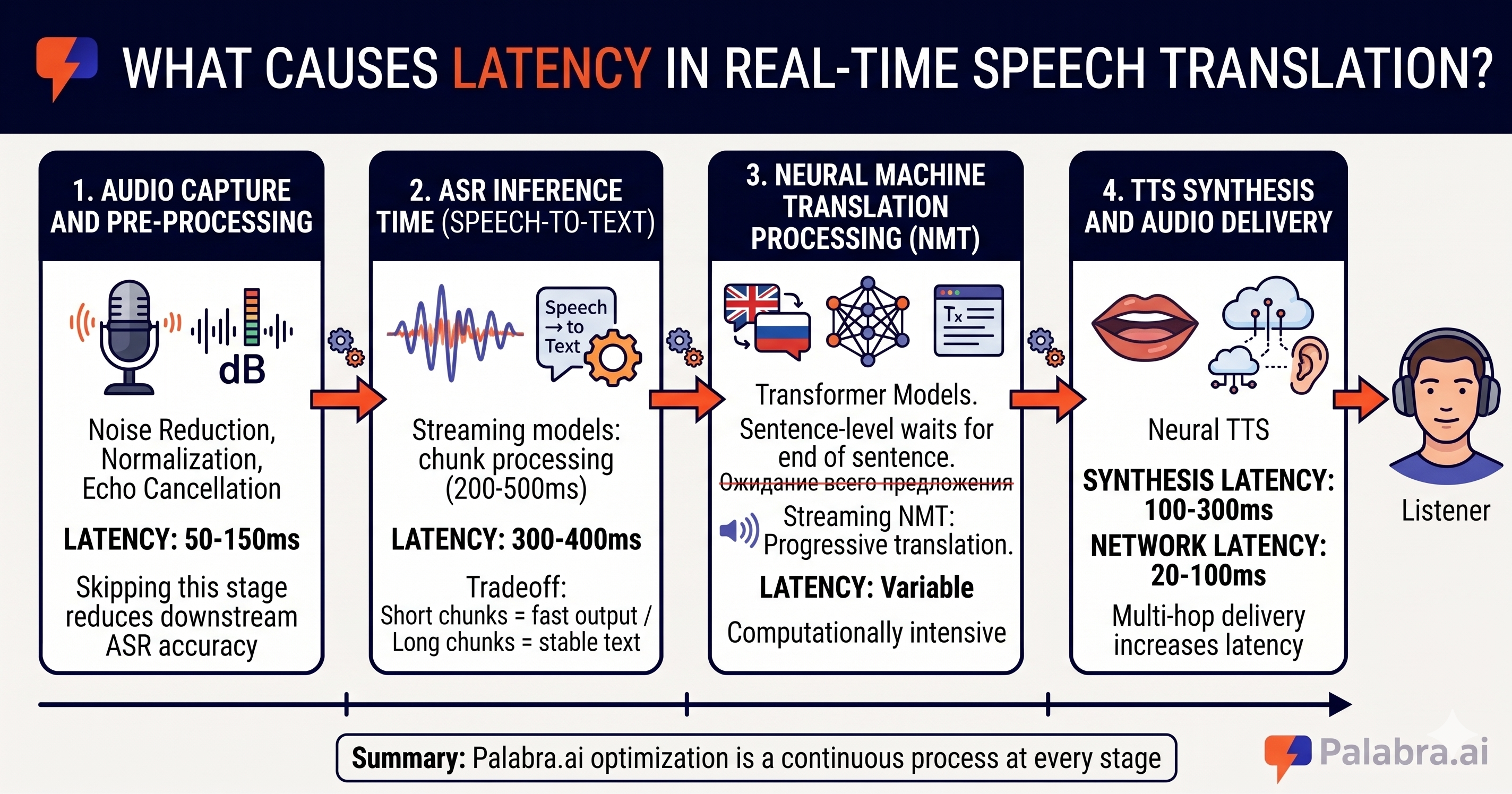
Latency does not come from a single source. It accumulates across every stage of the pipeline, and each stage has its own irreducible minimum processing time.
Audio Capture and Pre-Processing Delay
Before any AI model sees the audio, it must be captured, buffered, and pre-processed. Noise reduction, normalization, and echo cancellation all take time. On standard hardware, this stage adds 50-150ms. In environments with heavy background noise – conference rooms, live event venues – more aggressive pre-processing adds more delay. Systems that skip pre-processing for speed pay the cost in ASR accuracy downstream.
ASR Inference Time
Speech recognition requires accumulating enough audio context to make accurate predictions. Streaming ASR models process audio in chunks of 200-500ms, producing partial transcript updates as each chunk is processed. The tradeoff is inherent: shorter chunks produce faster partial outputs but with less context, leading to more corrections as later audio arrives. Longer chunks produce more stable transcripts but introduce more initial delay. Most production systems tune chunk size to 300-400ms as a balance point.
Neural Machine Translation Processing
Once a transcript is available, it must be translated. Neural machine translation models – particularly transformer-based architectures – are computationally intensive. A sentence-level NMT model must wait for a complete sentence before translating, adding the duration of the sentence itself to the latency budget. Streaming NMT models translate at the phrase or clause level, producing progressive translations that are refined as more of the sentence arrives – at the cost of occasional corrections when the sentence structure diverges from early predictions.
TTS Synthesis and Audio Delivery
The translated text must be converted to speech before the listener hears anything. Neural TTS synthesis adds 100-300ms depending on model size and output length. Audio delivery over network connections adds a further 20-100ms depending on geography and connection quality. In multi-hop delivery architectures – where audio passes through multiple servers before reaching the listener – this stage alone can account for several hundred milliseconds of the total latency budget.
Techniques That Reduce Latency
Streaming Architecture vs. Batch Processing
Batch processing waits for a complete audio segment – a sentence, a paragraph, or a fixed time window – before beginning any downstream processing. This simplifies the pipeline but guarantees latency equal to the batch duration plus processing time. Streaming architectures begin processing the moment audio starts arriving, running ASR, translation, and synthesis in a continuous pipeline where each stage feeds the next without waiting for upstream completion. Production real-time translation systems universally use streaming architectures.
Chunk-Based Inference and Partial Outputs
Streaming systems deliver partial outputs – incomplete transcripts and provisional translations – before the final version is ready. This reduces the time to first output dramatically: a listener hears the beginning of a translated sentence as the speaker is still finishing it, rather than waiting for the complete utterance. Partial outputs are refined in real time as more context arrives, with corrections blended smoothly into the audio stream.
On-Device Pre-Processing
Offloading audio pre-processing to the client device – the microphone hardware, a smartphone, or a dedicated earpiece – eliminates the network round-trip for the noisiest and most latency-sensitive stage. Clean, normalized audio arrives at the server-side ASR model ready for immediate inference, shaving 50-150ms from the pipeline before any AI processing begins.
Model Compression and Quantization
Smaller models run faster. Model compression techniques – knowledge distillation, pruning, and quantization – reduce model size by 50-80% with minimal accuracy loss, enabling inference that previously required a server-grade GPU to run on consumer hardware or compact cloud instances. For streaming ASR and NMT, smaller models running locally or on edge infrastructure can match the accuracy of larger cloud-hosted models while delivering significantly lower latency.
Hardware and Software Trade-offs
Dedicated Devices (Earbuds, Wearables)
Hardware translation devices like the Timekettle WT2 or Vasco V4 place computation close to the user, minimizing network latency for the delivery stage. Their limitation is model quality: consumer hardware cannot run the large neural models that deliver the best accuracy. Device-based translation is fast but constrained to the languages and domains its onboard models support.
App-Based Solutions
Smartphone translation apps offload heavy inference to cloud servers while handling audio capture locally. This delivers better model quality than dedicated devices but reintroduces network latency for the ASR and NMT stages. Performance varies significantly with connection quality – acceptable on a strong Wi-Fi connection, degraded on a congested mobile network.
Platform-Level AI (Google Meet, Zoom, MS Teams)
Integrated translation features in collaboration platforms benefit from optimized network infrastructure and pre-established connections between client and server. However, they are constrained by the platform’s architecture – translation runs as a feature within a larger product, not a purpose-built pipeline. Language coverage and accuracy are typically narrower than dedicated translation systems.
Full-Stack API Solutions
Full-stack translation APIs – where a single provider controls ASR, NMT, and TTS – eliminate inter-vendor network hops entirely. Each stage passes its output directly to the next within the same infrastructure, reducing both latency and error propagation. This architecture delivers the best combination of speed, accuracy, and language coverage for production deployments.
Where Latency Makes or Breaks the Experience
Live Events and Conferences
Conference interpreting has a well-established latency tolerance of three to five seconds – audiences are accustomed to this from human interpretation. AI translation systems that beat this threshold deliver a competitive live event experience. Systems that exceed it – particularly those that fall behind during fast-paced panel discussions or rapid Q&A – disrupt comprehension and erode audience trust in the technology.
Customer Support and Sales Calls
Bilateral conversation between an agent and a customer has far less latency tolerance than one-way conference interpretation. A two-second delay in a support call feels disruptive; a four-second delay makes the conversation feel broken. For contact centers deploying real-time translation at scale, latency performance under varying network conditions is a critical selection criterion.
Multilingual Corporate Meetings
All-hands meetings and town halls with multilingual audiences require translation that keeps pace with natural speech across multiple concurrent speakers. Speaker transitions – where one person stops and another begins immediately – are particularly demanding: the system must complete translation of the outgoing speaker’s final phrase while beginning to process the incoming speaker’s first words simultaneously.
Live Broadcasts and Streams
Live streaming introduces an additional constraint: audio-video synchronization. Translated audio must remain synchronized with on-screen video, which means translation latency must fit within the buffering window of the video stream. Most live streaming platforms buffer 2-5 seconds of video, giving translation systems a workable latency budget – but one that leaves little room for processing inefficiencies.
How Palabra Minimizes Latency End-to-End
Streaming-First Architecture
Palabra’s pipeline is designed around streaming from the ground up. Audio processing, ASR inference, translation, and TTS synthesis all run as continuous streaming operations rather than batch jobs. Partial outputs are delivered to listeners as they are generated, with refinements applied smoothly as more context becomes available. The result is a first-word latency – the time from speech start to first translated audio output – that is perceptibly faster than sentence-level batch systems.
Full-Stack Control from ASR to TTS
Palabra controls every component of the translation pipeline – audio pre-processing, ASR, NMT, and TTS synthesis – within a single integrated system. There are no network hops between vendor APIs, no serialization overhead at integration boundaries, and no latency introduced by inter-system authentication or request queuing. Each stage passes its output directly to the next within the same infrastructure, compressing end-to-end latency to the irreducible minimum that the underlying models require.
Why Single-Vendor Pipelines Are Faster
Multi-vendor pipelines – where ASR comes from one provider, translation from another, and TTS from a third – introduce latency at every integration point. Each API call adds network round-trip time, authentication overhead, and serialization cost. A system that makes three sequential API calls to deliver one translated sentence accumulates these costs three times. Palabra’s single-vendor architecture eliminates this overhead entirely, delivering real-time multilingual output across 60+ languages at the latency that live communication actually demands.