People say "translator" when they mean "interpreter" all the time, and in casual conversation nobody minds. When you are booking language services for a conference, a patient visit or a product launch, the interpreter vs translator distinction decides who you hire, how you pay, and what you get back. This guide covers the work, the training, the tools, the pay, and where AI real-time translation fits.
Interpreter vs translator at a glance
The short answer on the interpreter vs translator difference: an interpreter works with spoken or signed language, live. A translator works with written text and has time to refine it. The American Translators Association’s guide to buying translation services puts it plainly: translators adapt written text from one language to another, while interpreters work with spoken language. The National Association of Judiciary Interpreters and Translators draws the same line for legal work: interpreters transfer oral speech, translators transfer written texts.
So what does interpreter mean in practice? An interpreter listens to a speaker in the source language and delivers the message in the target language while the conversation is still happening. Interpreters are the people in the booth at a summit, beside a patient in an exam room, or on the line between a caller and an agent. They rely on listening and speaking skills, and they read tone, gestures, facial expressions and general body language to carry meaning across.
A translator starts with a document: a contract, a website, a manual, marketing copy. They can research terms, draft, revise and send the work to a reviewer before anything reaches the reader. The real difference between translation and interpretation is time. A translator can spend an hour on one sentence. An interpreter has a few seconds.
| Interpreter | Translator | |
|---|---|---|
| Medium | Spoken or signed language | Written text |
| Input | A live speaker | A source document or file |
| Output | Speech or sign in the target language | A finished written text |
| Speed | Real time, or right after each segment | Hours to weeks, with revision |
| Working tools | Booths, headsets, microphones, remote interpreting platforms | CAT tools, translation memory, termbases, dictionaries |
| Typical settings | Conferences, courts, hospitals, meetings, calls | Contracts, records, websites, software, marketing copy |
People often say interpreter or translator interchangeably, and both jobs demand deep command of two languages and their cultural nuances. They are still separate professions, trained and certified separately. One hybrid task, sight translation, sits between them and is covered below.
AI has added a third option for spoken communication: software that listens, translates and speaks in real time. If you want the mechanics first, see what real-time audio translation actually does.
atanet.org: What is the Difference Between Translation and Interpreting? – American Translators…
What interpreters and translators actually do
Both professions move meaning from one language to another, but the daily work looks nothing alike. Interpreters choose a mode that fits the setting. Translators follow a multi-step production workflow. Here is how each one works.
How interpreters work: consecutive, simultaneous and other modes
Interpreting is described by how the interpreter handles the message, and the modes overlap.
- Consecutive interpreting. The speaker pauses, and the interpreter renders that segment in the target language. AIIC, the international association of conference interpreters, describes this as waiting for a segment to finish before rendering it. It often requires extensive note-taking. You see it in medical visits, depositions and small business meetings.
- Simultaneous interpreting. The interpreter speaks almost as the speaker does. ATA notes that this is not literally instantaneous: interpreters keep a deliberate lag of a few words, called décalage, so they can grasp a complete thought before speaking.
- Whispered interpreting (chuchotage). Simultaneous interpreting without a booth, murmured to one or two listeners. AIIC warns that ambient sound and the interpreter’s own voice can interfere with listening, and recommends portable equipment where appropriate.
- Sight translation. Written input, oral output. ATA’s example is a judge handing an interpreter an English document to read aloud to a defendant in Portuguese.
- Sign-language interpreting. The Bureau of Labor Statistics explains that ASL has its own grammar and is separate from English, and describes approaches such as tactile signing. It is a language, not English spelled out by hand.
- Remote and phone interpreting. The interpreter works from another location over video or a phone line. Remote describes delivery, not who does the work: a remote interpreter is still a human professional. For how this compares with AI platforms at events, see our analysis of conference interpretation services.
Mode choice has practical consequences. Consecutive roughly doubles the time a meeting takes but needs no equipment. Simultaneous keeps the pace of a conference but needs booths or a platform, and usually a team of interpreters rotating through long sessions.

Four key facts about conference interpreting, from AIIC: what it does, consecutive and whispered modes, and the equipment.
Translators, by contrast, follow a production process rather than choosing a mode. A typical translation project runs like this:
- Source text analysis. The translator reads the full document, flags ambiguous passages and checks the purpose and audience.
- Terminology research. Technical terms, product names and legal phrases are confirmed against client glossaries and reference material.
- Drafting. The translator writes the target text, aiming for meaning and tone rather than word-for-word equivalence.
- Revision. A self-edit against the source for accuracy, omissions and style.
- Review and QA. A second linguist reviews, and checks cover numbers, formatting and consistency.
- Delivery. The final file goes back in the agreed format.
Localization extends this for websites, apps and marketing copy. It adapts dates, units, currencies, idioms and humour so the text reads as if it were written in the target market, which can mean rewriting a slogan rather than translating it.
Skills and training: how each path is built
The skill sets diverge more than most people expect. Interpreters need sharp listening, short-term memory, note-taking, split attention and composure under pressure. Translators need excellent writing in the target language, patient research, terminology management and an eye for consistency across thousands of words. Many strong translators would struggle in a booth, and the reverse is just as true.
Formal routes reflect that split. BLS identifies a bachelor’s degree as the typical entry-level education; translators may hold translation-studies degrees, or education and experience in a subject such as law or medicine. Credentials, though, are task-specific:
- ATA certification covers written translation in one language pair and direction. ATA’s certification guide describes a three-hour proctored exam with continuing-education requirements, available in more than 30 language pairs. ATA also notes that certification is not required to offer translation services in the US, and that a "certified translation" simply means a translation with a signed statement of accuracy.
- Healthcare interpreting. CCHI’s candidate handbook requires candidates to be at least 18, hold a high-school diploma or equivalent, show proficiency in English and another language, and complete at least 40 hours of healthcare-interpreter training. Language-specific CHI credentials exist for Arabic, Mandarin and Spanish.
- Court interpreting. The Federal Court Interpreter Certification Examination is currently offered for Spanish/English only: a written screening phase, then an oral exam testing sight translation, simultaneous and consecutive interpretation. BLS adds that most states require court-interpreter certification.
| Skill or requirement | Interpreter | Translator |
|---|---|---|
| Core skill | Listening, memory, real-time delivery | Writing, research, terminology |
| Note-taking | Essential for consecutive | — |
| Typical education | Bachelor’s degree (BLS) | Bachelor’s degree (BLS) |
| Main certification | CCHI (healthcare), FCICE and state courts (legal) | ATA (by language pair and direction) |
| Cross-validity | Interpreting credentials test spoken performance | ATA certification does not assess interpreting skills (NAJIT) |
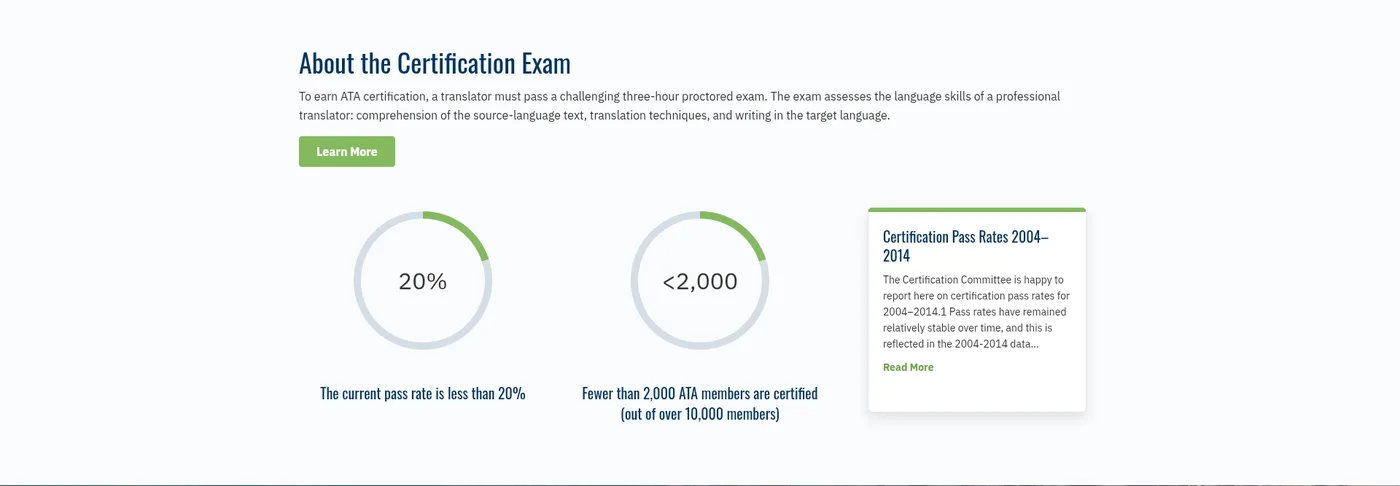
ATA’s Guide to Certification describes the proctored certification exam, taken in one language pair and direction
Can one person do both jobs? Yes, and many do. But each skill must be proven separately: as NAJIT points out, a translation credential does not establish interpreting competence.
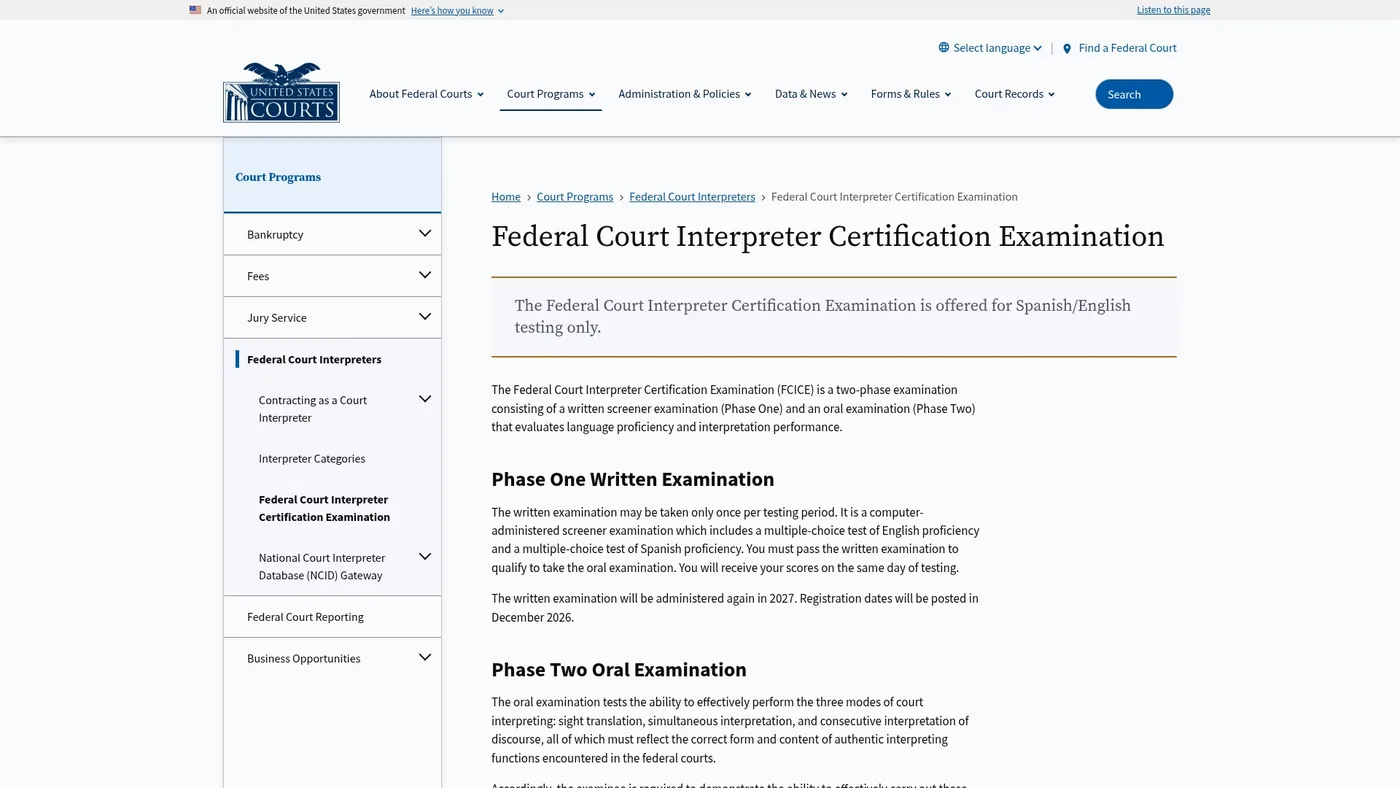
The federal court interpreter exam tests sight translation, simultaneous and consecutive interpreting
Tools of the trade: CAT tools, interpreting equipment and AI
Translators and interpreters both lean on technology, but for different jobs. Translators use software to manage written text. Interpreters use audio and video equipment to deliver language during a live interaction.
On the translation side, computer-assisted translation (CAT) is the core category. ATA’s buyer guide defines CAT tools as software that increases a human translator’s productivity and consistency, and distinguishes them from machine translation, which translates text automatically. Computer-aided translation keeps the human in charge.
Inside a CAT environment, the translation memory does the heavy lifting. The European Commission describes a translation memory as paired source text and human translations, stored in units of sentences or parts of sentences, so translators can reuse previous work. Glossaries and termbases work at the word and phrase level, keeping a product name or legal term identical across every file. Many teams also use machine translation post-editing, where a translator corrects machine output instead of drafting from scratch. For an overview of the software side, see our guide to language translation tools.
Interpreting technology is about sound. AIIC describes soundproof booths, microphones and headphones for simultaneous conference work. Remote platforms move the booth online. Interprefy’s Zoom integration page describes interpreters receiving Zoom audio and video through its console and streaming their interpretation into Zoom language channels. Webex documentation describes interpreters listening to the original audio and translating into a target-language channel, and warns that recordings capture only the original audio. In relay interpreting, one interpreter works from another’s output when no one covers the direct language pair.
| Tool category | Used by | What it does |
|---|---|---|
| CAT tools | Translators | Workspace for drafting, QA and consistency |
| Translation memory | Translators | Reuses previously translated segments |
| Glossaries and termbases | Translators (and interpreters preparing) | Fixes approved terminology |
| Booths, microphones, headsets | Conference interpreters | Isolates sound for simultaneous work |
| Remote interpreting platforms | Remote interpreters | Feeds audio to interpreters and returns language channels |
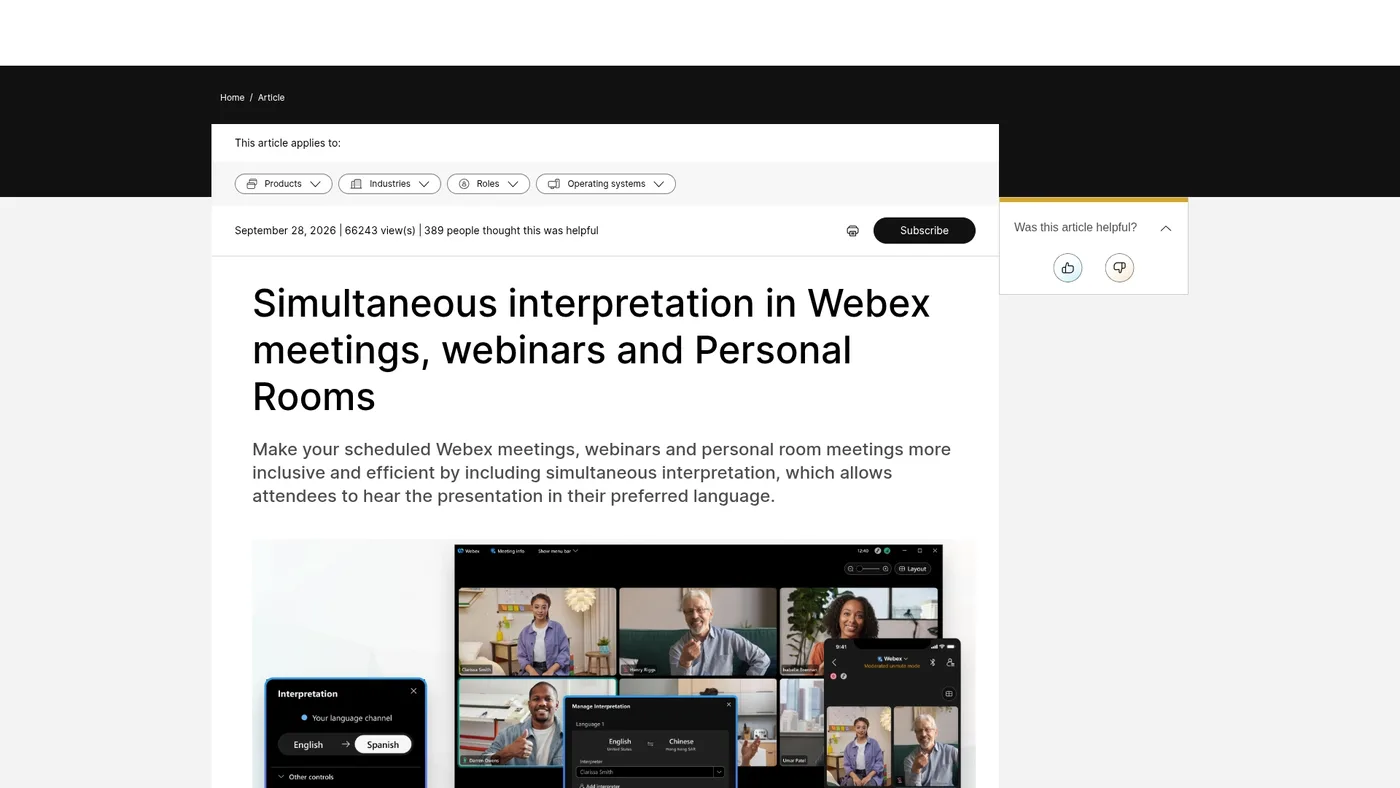
Webex documentation on running human simultaneous interpretation through meeting language channels
Specialisations: medical, legal, conference and sign language
The split between spoken and written work shows up clearly in specialised fields. Healthcare is the clearest worked example of medical interpreter vs medical translator.
A medical interpreter supports a live conversation between a patient and a clinician. HHS language-access guidance gives the example of a hospital providing a qualified interpreter promptly and at no charge, so the patient and provider can talk in the patient’s language. It also cautions that someone who speaks both languages is not necessarily a qualified interpreter. A medical translator produces written material: consent forms, discharge instructions, records and patient leaflets.
The regulation keeps the roles apart too. 45 CFR 92.201 requires covered entities to offer a qualified interpreter when interpretation is required and a qualified translator when translation is required. Credentials follow the same line. NBCMI offers a non-language-based Hub-CMI credential after its written exam, and full certification in six languages: Spanish, Mandarin, Cantonese, Russian, Korean and Vietnamese. Like CCHI, these certify interpreting, not document translation.
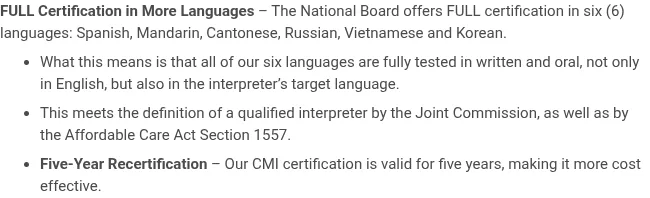
NBCMI’s medical interpreter certification, offered in full for six languages
Legal work divides the same way. Court interpreters handle hearings, testimony and attorney-client meetings, while legal translators handle what NAJIT lists as judgments, forensic reports, extradition documents, statutes and contracts. In conference work, interpreters cover the live sessions and translators handle programmes, slides and proceedings. In sign language, interpreters work live between a signed and a spoken language.
| Field | Interpreter task | Translator task |
|---|---|---|
| Medical | Patient visits, consultations, consent conversations | Consent forms, discharge instructions, records |
| Legal | Hearings, testimony, depositions | Contracts, judgments, statutes |
| Conference | Keynotes, panels, Q&A | Programmes, slides, proceedings |
| Sign language | Live signed and spoken interpreting | — |
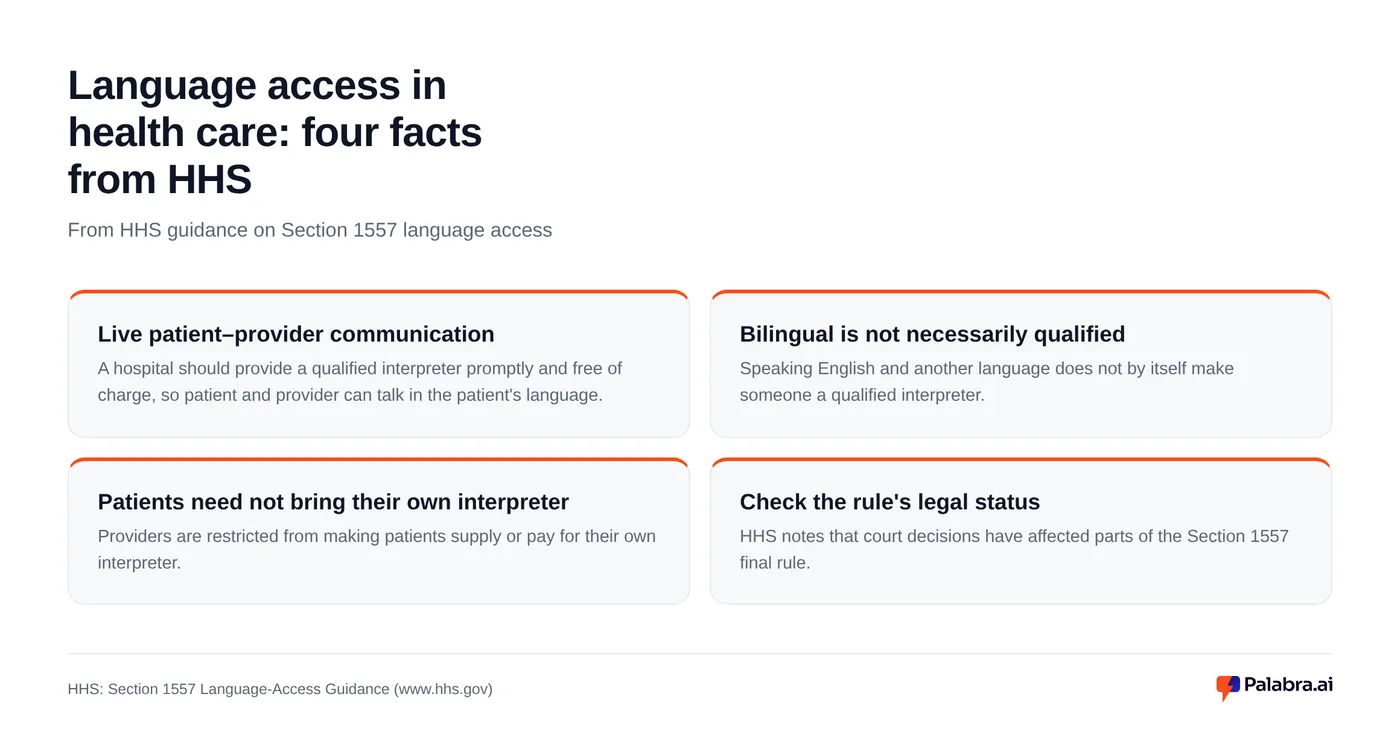
Four facts from HHS’s Section 1557 guidance on language access in health care
Careers and pay: interpreter vs translator salary
Most national pay data treats the two jobs as one occupation, so it cannot settle the translator vs interpreter salary question on its own. BLS counts 73,900 interpreter and translator jobs in the US in 2025, with a May 2025 median employee wage of $60,170 a year, or $28.93 an hour. The lowest-paid 10% earned under $37,070 and the highest-paid 10% over $103,660. BLS projects 2% employment growth from 2025 to 2035, with about 6,000 openings a year.
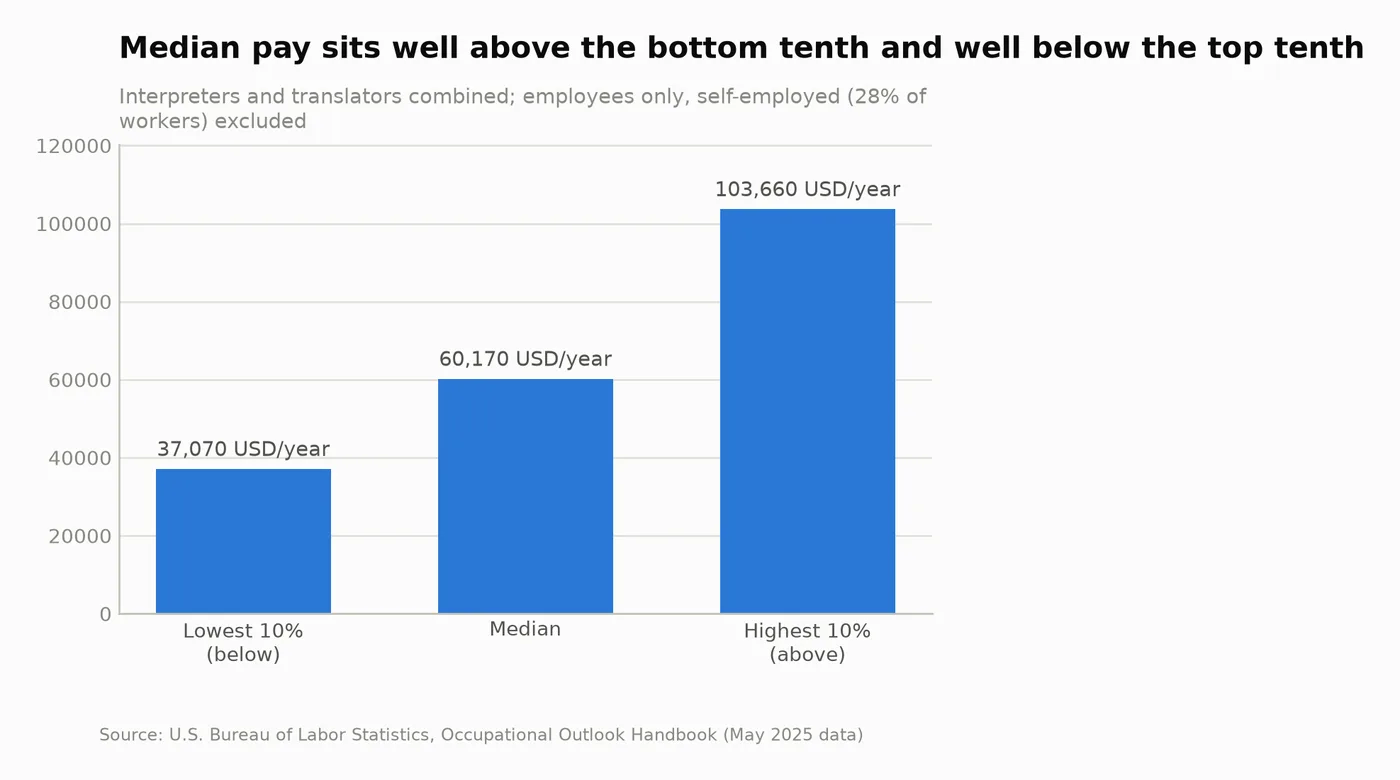
Annual wages for US interpreters and translators combined, May 2025 (USD). Source: BLS, employees only
There is a big caveat. BLS lists 28% of the occupation as self-employed and excludes them from its wage data, so the median says little about freelance income. Pay structures differ too. Written translation is commonly priced per word: one GSA contractor catalog lists $0.1814 per word for Latin American Spanish and Russian, a contract-specific example rather than a market rate. Interpreting is usually billed by time, and in federal courts contract-interpreter compensation is regulated separately, distinguishing certified interpreters from language-skilled ones. In practice, certification and specialisation move earnings more than the job title does.
| Interpreter | Translator | |
|---|---|---|
| Pay basis | Time (session, hour or day); court fees set by policy | Per word or per project |
| Typical employers | Courts, healthcare providers, conference organisers | Language service companies, government contractors |
| Outlook (BLS, combined) | 2% growth 2025–2035 | 2% growth 2025–2035 |
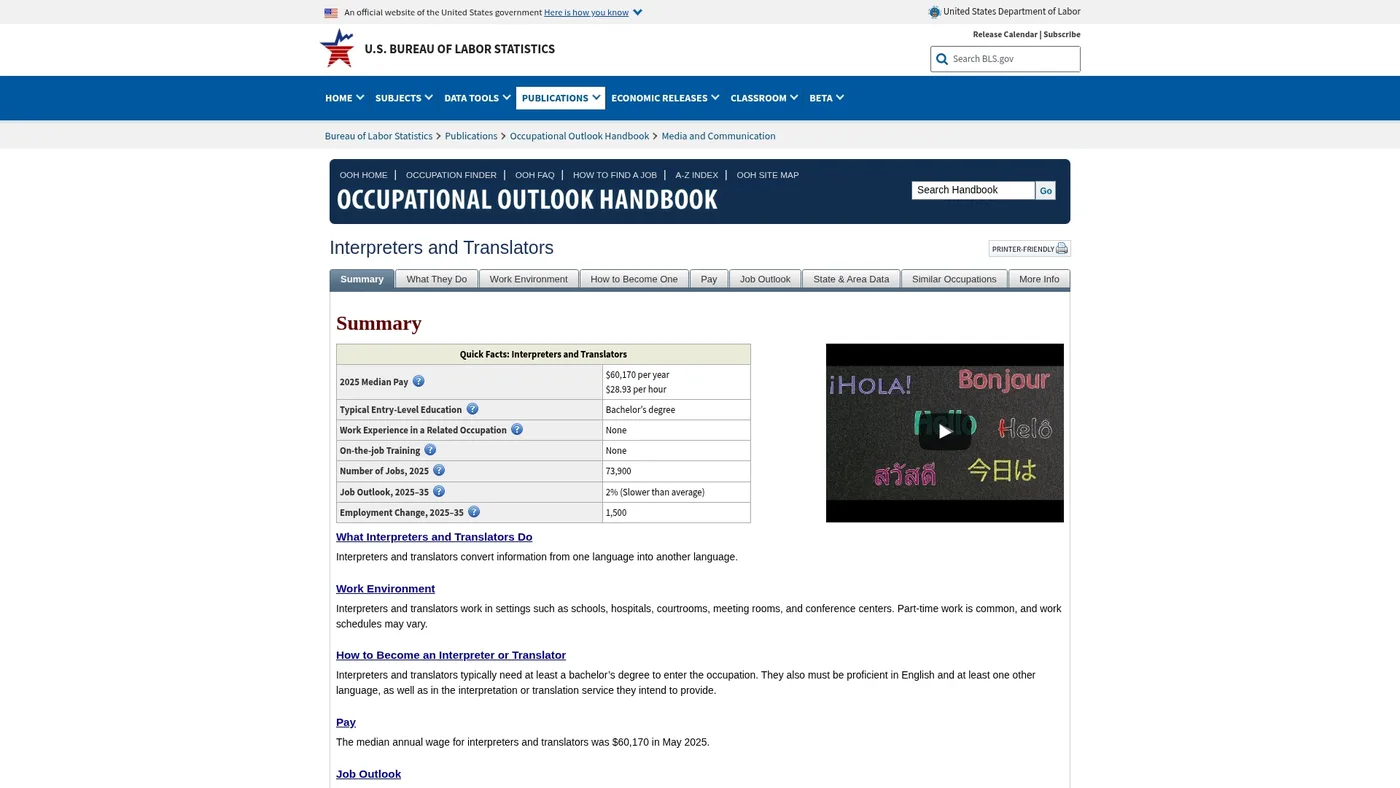
The BLS Occupational Outlook Handbook entry for interpreters and translators
Which is better, translator or interpreter? Neither; it depends on temperament. If you are weighing the two careers:
- Interpreting suits you if you think fast, enjoy people, stay calm under pressure and like work that ends when the session ends.
- Translation suits you if you love writing, research and getting a sentence exactly right, and prefer to work at your own pace.
- Both can suit you if you build the separate skills and credentials each one requires.
Hiring a professional or using AI real-time translation
For events, support and localization teams, the decision comes down to stakes and medium. Written material that carries legal or clinical weight needs a translator. Live speech in a regulated or high-stakes setting needs a qualified interpreter. Large volumes of everyday spoken communication, such as meetings, webinars, conferences and streams, are where AI real-time translation now earns its place.
The evidence on machine translation supports careful use, not blanket replacement. In a BMJ Quality & Safety study of discharge instructions, sentence-level accuracy was high, but whole instruction sets with at least one error varied widely by language. A second blinded study found machine output non-inferior to professional interpreters on several accuracy dimensions, yet less fluent in Spanish and Portuguese. In legal settings, 28 USC 1827 sets the use of certified interpreters in specified federal proceedings, and the healthcare rule requires qualified human review of machine-translated text that is critical to rights or access.
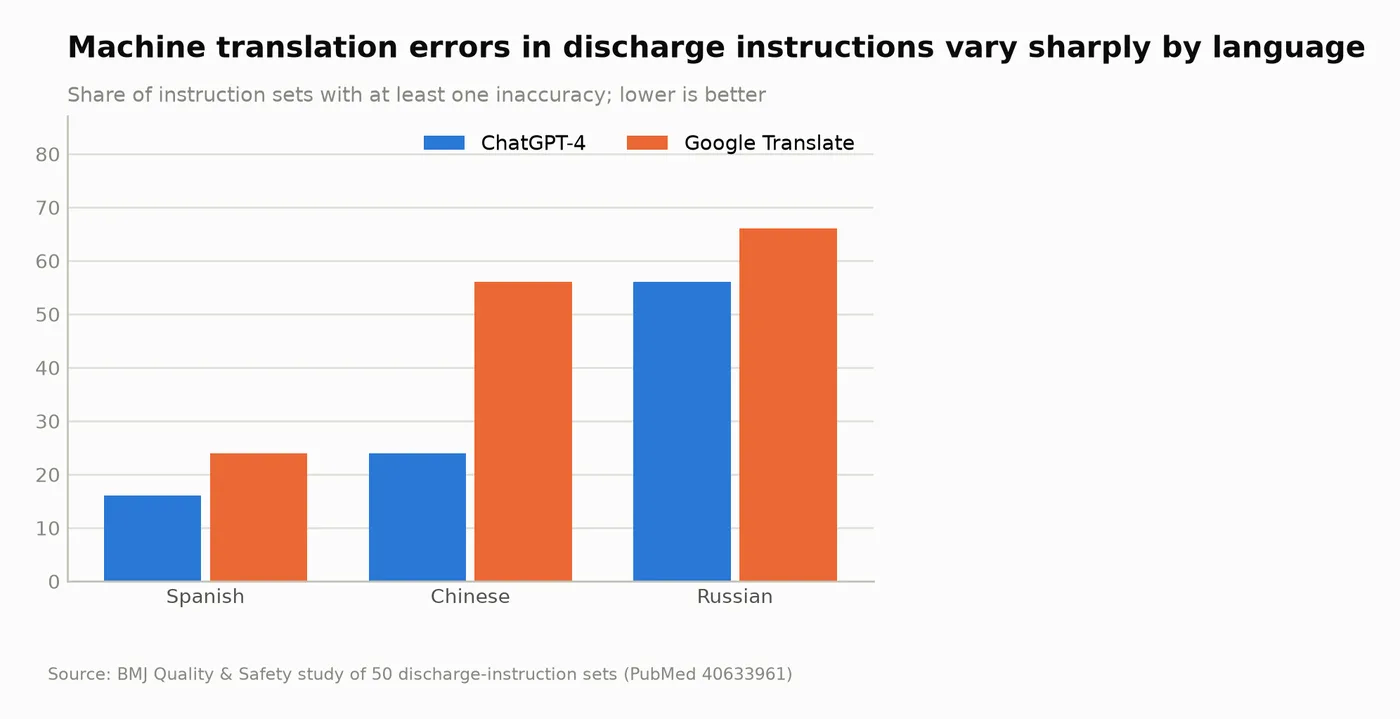
Share of discharge-instruction sets with at least one inaccuracy, by language and tool (BMJ Quality & Safety study)
For spoken communication outside those settings, Palabra runs its own speech models end to end and speaks the translation in under a second, with live captions, across 60+ languages. Audio and text are never stored or used for training. In online meetings, a bot joins Zoom, Google Meet or Microsoft Teams; only the organizer needs a subscription, from $60 a month with 3 hours included. Webinar translation lets every viewer pick a language from a link.

Palabra’s meeting translator joins Zoom, Google Meet and Teams calls
For in-person events, attendees scan a QR code and listen on their own phones, with no booths or headsets, from $500 a month. Streams start at $300 a month, and developers can build on the speech-to-speech API at $0.04 per minute. People and teams from organizations including UNICEF and DHL use Palabra.
| Situation (B2B) | Hire | Why |
|---|---|---|
| Court hearing, deposition | Certified court interpreter | Certified interpreter where reasonably available under federal rules |
| Patient consultation | Qualified medical interpreter | Federal language-access rules |
| Contracts, consent forms | Qualified translator | Written text with legal weight |
| Team meetings, sales and support calls | AI real-time translation | Live, frequent, in many language pairs |
| Conferences, webinars, streams | AI real-time translation, or interpreters for keynote diplomacy | Scale without booths |
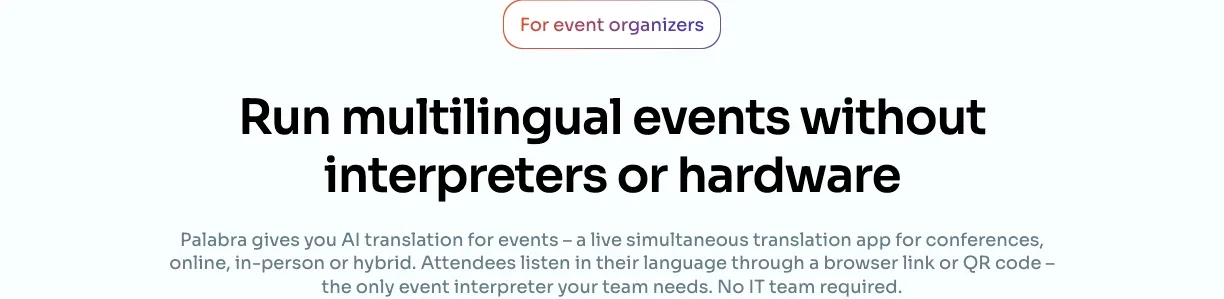
Palabra for events: attendees listen through a QR code on their own phones
To plan a larger rollout, talk to the Palabra team, or start a free trial and hear your next meeting in your audience’s language.