What is interpreting? A plain definition
What is interpreting? It is the live conversion of a spoken or signed message from a source language into a target language, so people who share no language can still talk. The National Council on Interpreting in Health Care (NCIHC) gives the standard interpreting definition: understanding and analyzing a spoken or signed message and re-expressing it faithfully and accurately in another language. When professionals define interpreting, the word "signed" matters. Sign language interpreting is full interpreting, not a side category.
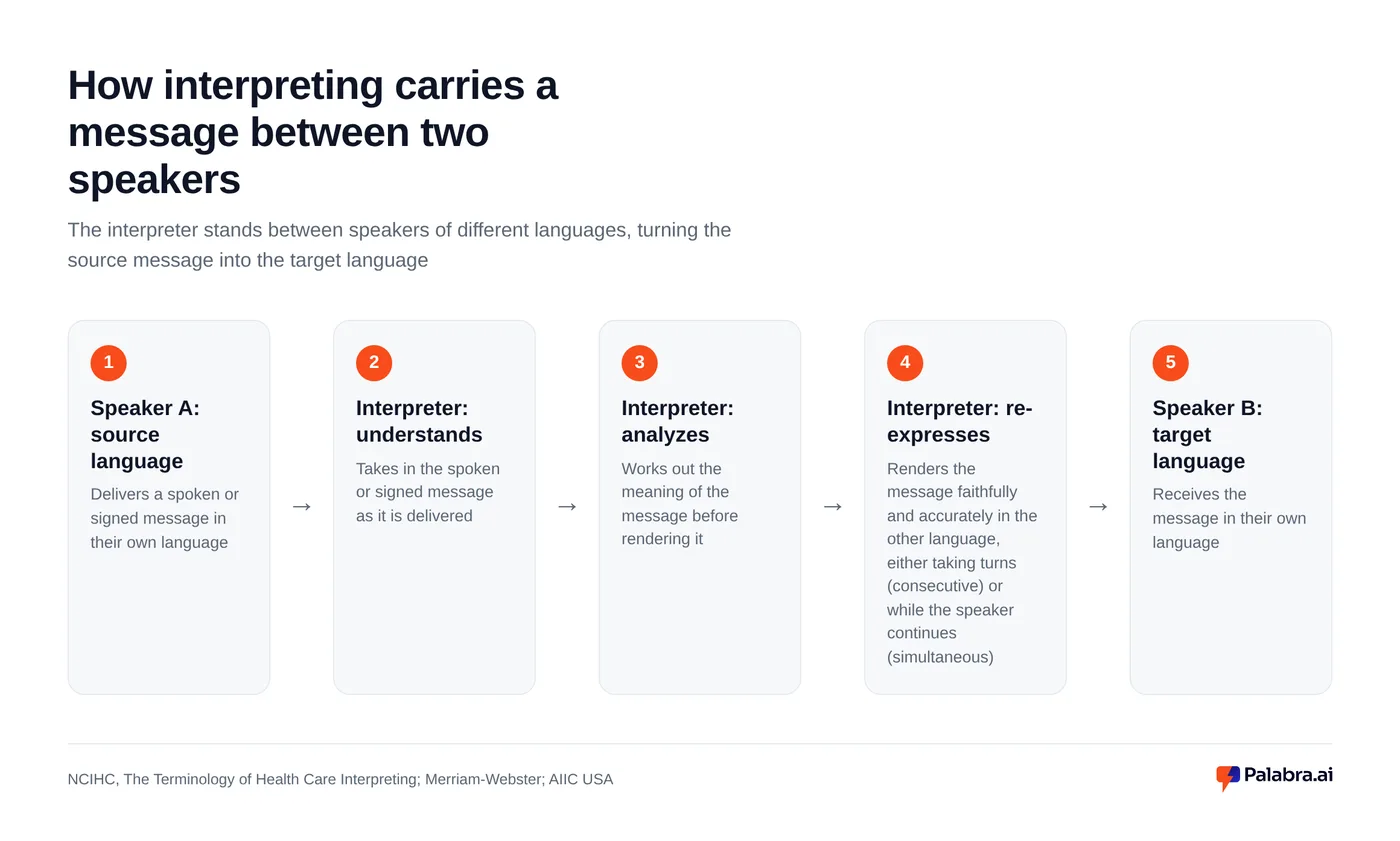
Interpreting as NCIHC defines it: an interpreter between two speakers understands and analyzes a spoken or signed message, then re-expresses it faithfully in the other speaker’s language.
Interpreting, in one sentence: a person or system listens to (or watches) a message in one language and delivers its meaning in another, live.
Here is a simple example. A French supplier on a video call says the parts will arrive "dans deux semaines, pas une." The interpreter tells the English-speaking buyer "in two weeks, not one," keeping the emphasis, then carries the buyer’s reply back into French. What crosses over is meaning and intent, not a word-for-word transcript. Software now handles pairs like this too, as in real-time AI translation from French to English.
The word itself causes confusion because "interpretation" has various interpretations. Merriam-Webster’s entry for "interpret" lists the language sense, "to act as an interpreter between speakers of different languages," next to broader meanings such as explaining or construing something. It traces the verb back through Anglo-French to the Latin interpres, an agent or negotiator. A different interpretation of a poem or a contract has nothing to do with languages.

Merriam-Webster’s entry for the verb ‘interpret’ lists ‘to act as an interpreter between speakers of different languages’ alongside broader senses such as explaining and construing.
NCIHC treats "interpreting" and "interpretation" as meaning the same thing in language work, but prefers "interpreting" because it stresses a process rather than a product. So whether someone asks what is interpreting or what is language interpretation, the answer is the same: real-time spoken or signed communication across languages.
Interpreting vs translation: the difference
Interpreting and translation solve the same problem in different media. NCIHC draws the line at the output: interpreting produces a message orally or manually, while translation converts written text into written text in another language. The American Translators Association puts it as translators write and interpreters talk. Add "or sign" and the shorthand holds. It is not a split between approximate and accurate work: both aim for faithful meaning.

ATA’s client guide explains the difference between translation and interpreting
| Interpreting | Translation | |
|---|---|---|
| Medium | Spoken or signed | Written |
| Timing | Real time, or a few words behind the speaker | Hours to weeks, with revision |
| Tools | Booths, headsets, remote platforms, notepad, glossaries | Translation software, termbases, dictionaries, reference texts |
| Accuracy | Faithful meaning under time pressure | Faithful meaning with time to verify every term |
| Skills | Listening, memory, public speaking, split attention | Writing, research, editing |
| Nonverbal cues | Tone, pauses and body language are part of the message | Limited to what the text carries |
| Typical output | A live speech, a dialogue, a signed rendering | A document, website or subtitle file |

An illustration of the two jobs: an interpreter rendering live speech from a booth, and a translator revising a written text at a desk.
Timing drives most of the other differences. A translator can research a term, revise and have a colleague review the text before delivery. An interpreter decides in seconds, so the preparation happens beforehand: glossaries, speaker notes, slides. Direction differs too. ATA notes that most translators work in one direction, say English to Japanese, while an interpreter in a two-way conversation handles both sides.
The terms get mixed up for good reasons. Everyday speech says "translate" for both, many agencies sell translation and interpreting services as one bundle, and sight translation (covered below) starts from a written page but ends as speech. If you are comparing tools for written text and live speech side by side, our guide to the best translation apps and services separates the two.
Modes of interpreting: consecutive, simultaneous, whispered and sight translation
Interpretation types start with mode: how the interpreter times the output against the speaker. ATA names three main modes: consecutive, simultaneous and sight translation. AIIC, the international association of conference interpreters, also describes whispered interpreting as a variant of simultaneous. Phone, video and onsite are delivery arrangements, covered later.

The four interpreting modes: consecutive, simultaneous, whispered (chuchotage) and sight translation.
| Mode | How it works | Equipment | Typical settings | Pros | Limits |
|---|---|---|---|---|---|
| Consecutive | Speaker pauses; interpreter renders the segment | Notepad and pen | Medical visits, depositions, small meetings | No gear needed; room to clarify | Adds time, since every segment is said twice |
| Simultaneous | Interpreter speaks while the speaker continues, a few words behind | Soundproof booths, microphones, headphones | UN meetings, conferences, academic events | Natural pace; many languages at once | Needs equipment and intense concentration |
| Whispered (chuchotage) | Simultaneous, spoken quietly to one or two listeners | None, or portable equipment | Site visits, groups moving between venues | Flexible, no booth | Ambient noise and the interpreter’s voice can disturb others |
| Sight translation | A written document read aloud in another language | The document | Courts, clinics, intake forms | Fast access to a text | Leaves no written record |
Consecutive interpreting follows a simple rhythm: the speaker and interpreter take turns. AIIC points to short meetings and situations without interpreting equipment as natural fits. Because a segment can run a minute or more, note-taking for consecutive interpreting is a craft of its own: interpreters use personal symbols for numbers, names and the logic of an argument rather than writing every word. Two-way consecutive work in clinics and public services is often called dialogue interpreting, the subject of Rebecca Tipton’s work on the field.
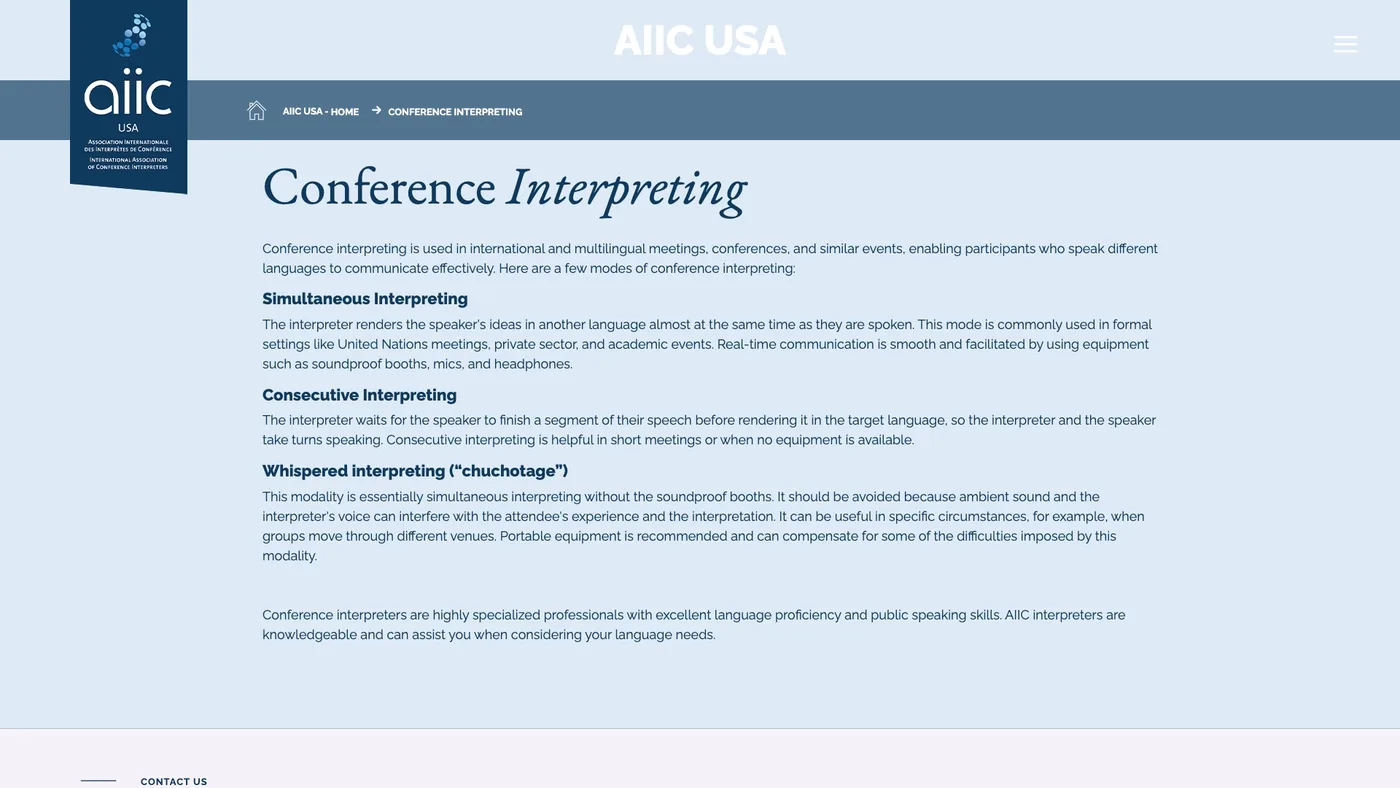
AIIC USA describes consecutive, simultaneous and whispered interpreting and the equipment each needs
Simultaneous interpretation is delivered almost at the same time as the original speech, typically at UN meetings, private-sector conferences and academic events. "Simultaneous" does not mean zero delay. ATA explains that interpreters deliberately lag a few words behind, a gap called décalage, so they can render a complete thought. Our explainer on how AI simultaneous interpretation works shows how software handles the same trade-off.
Whispered interpreting, or chuchotage, is simultaneous without the booth. AIIC warns that ambient sound and the interpreter’s own voice can interfere, though it suits groups moving between venues, and portable interpreting equipment helps. Sight translation turns a written document into spoken or signed language. ATA’s example is a judge handing an English document to an interpreter to read to a defendant in Portuguese.
Consecutive dominates real-world assessment. The Certification Commission for Healthcare Interpreters (CCHI) weights its CHI performance exam heavily toward it.

Weighting of CCHI’s CHI healthcare interpreter exam by mode (%), per CCHI
Types of interpreting by setting
Mode is how; setting is where, and each setting adds its own demands. The US Bureau of Labor Statistics lists schools, hospitals, courtrooms, detention facilities and conference centers as interpreter workplaces, and many interpreters also work remotely. These are the main types of interpretation services:
- Conference interpreting. Multilingual meetings, summits and congresses, mostly simultaneous. AIIC calls conference interpreters highly specialized professionals with strong language proficiency and public-speaking skills. Topic preparation and terminology are the daily grind.
- Medical interpreting. Interpreting between patients and clinicians, mostly consecutive, under strict confidentiality. Under HHS guidance on Section 1557, where interpretation is required in covered healthcare, the interpreter must be qualified, and speaking two languages is not enough.
- Legal interpreting. Hearings, depositions and trials, with frequent sight translation and close attention to exact wording. Federal law (28 USC 1827) sets up a program for certified and otherwise qualified interpreters in federal proceedings. State courts run their own systems.
- Community interpreting. Dialogue interpreting in public services: schools, social services, housing offices, local government. The stakes are personal, and the interpreter often bridges cross-cultural gaps as well as words.
- Sign language and ASL interpreting. Interpreting between American Sign Language and spoken English for deaf and hard of hearing people. RID’s certification pathways separate the National Interpreter Certification for hearing interpreters from the Certified Deaf Interpreter credential for Deaf or hard-of-hearing interpreters.
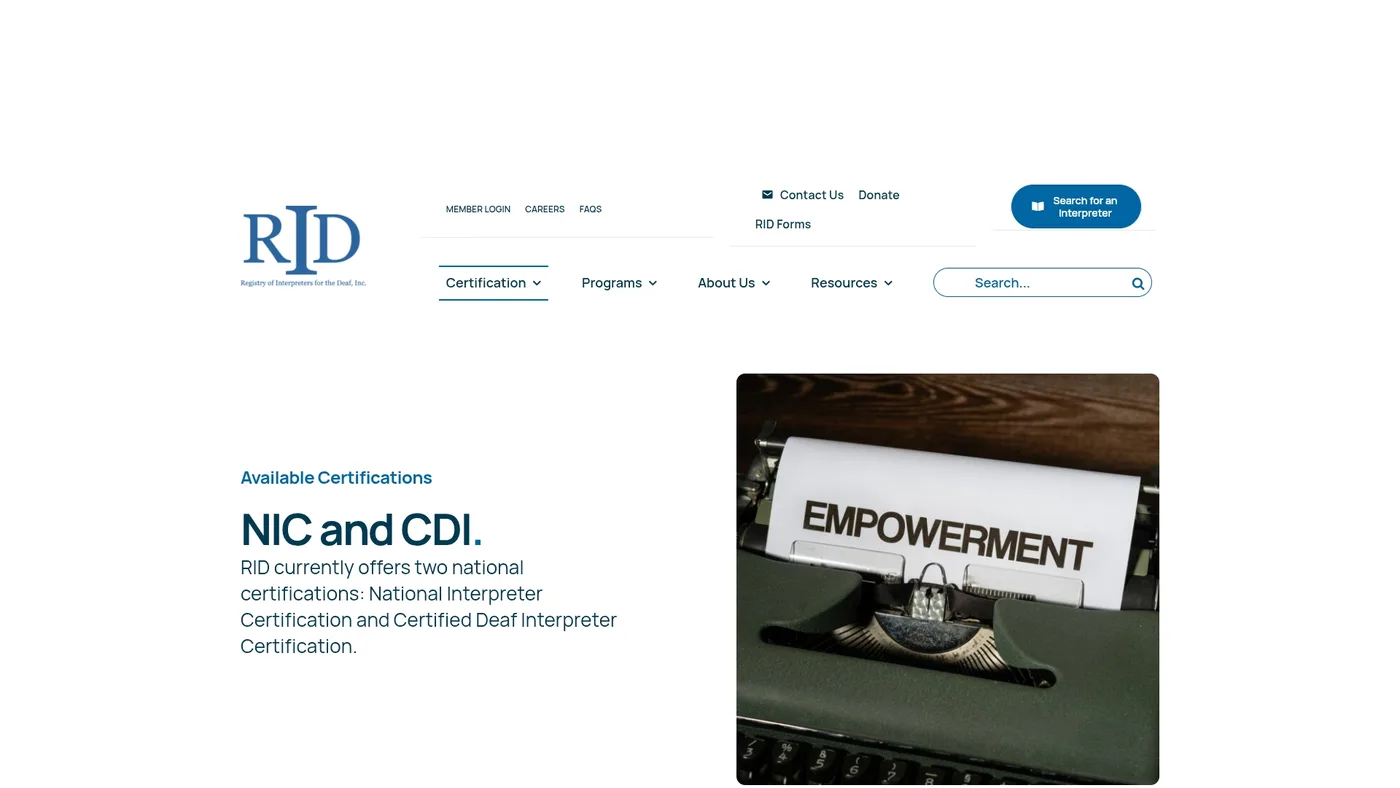
RID lists its ASL interpreter credentials, including NIC and CDI
For deaf people, the Department of Justice’s ADA guidance on effective communication ties the right aid to the situation. A written note may do for a simple question, while taking a medical history or discussing a serious diagnosis may need an interpreter. For a deeper look at the conference side, see our comparison of professional conference interpreters and AI platforms.

DOJ’s ADA guidance explains how the right communication aid depends on context
Remote, video and AI interpreting
Remote interpreting delivers the same modes without an interpreter in the room. Over-the-phone interpreting (OPI) is the simplest: Boostlingo’s solutions page describes it as connecting people to interpreters by phone. It powers inbound call interpreting on support and service lines, often as one-call interpreting, where a single call brings a language specialist into the conversation.
Video remote interpreting (VRI) adds the picture. LanguageLine’s VRI page describes a live video link where participants and a qualified interpreter see and hear each other in real time, which is essential for sign language. The DOJ guidance cited above sets a bar for it: real-time, full-motion video, a clear image, audible voice and trained staff. Meeting platforms build interpreter channels in too: Zoom’s language interpretation feature lets hosts assign up to 200 participants as interpreters, each with their own audio channel, in scheduled meetings and webinars.
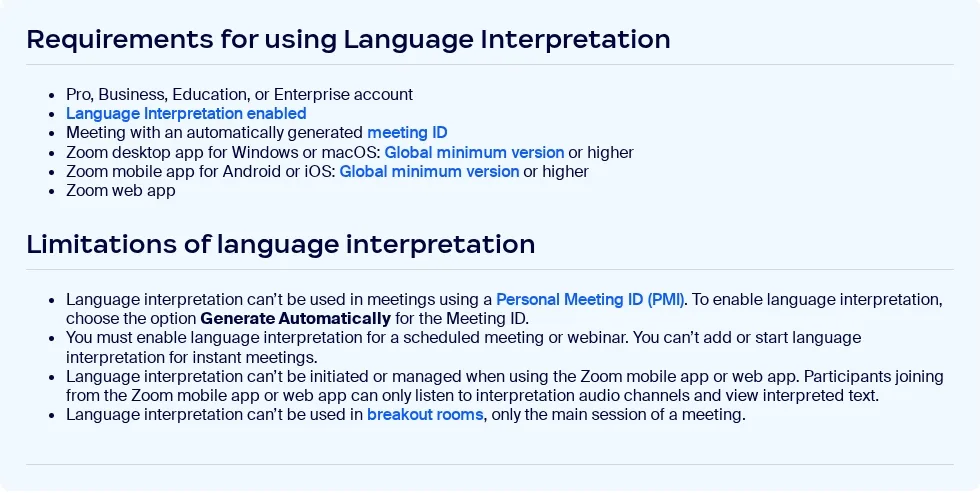
Zoom’s help article walks hosts through enabling language interpretation in their settings.
Published rates show why remote delivery spread. Remoto by ProZ lists $0.42 to $1.87 per minute for its most-requested pairs, with an English–Spanish median of $0.72. The same page puts traditional providers at roughly $1.50 to $4 per minute for phone, $3 to $5 for video, and $50 to $150+ per hour onsite, plus minimums and travel.
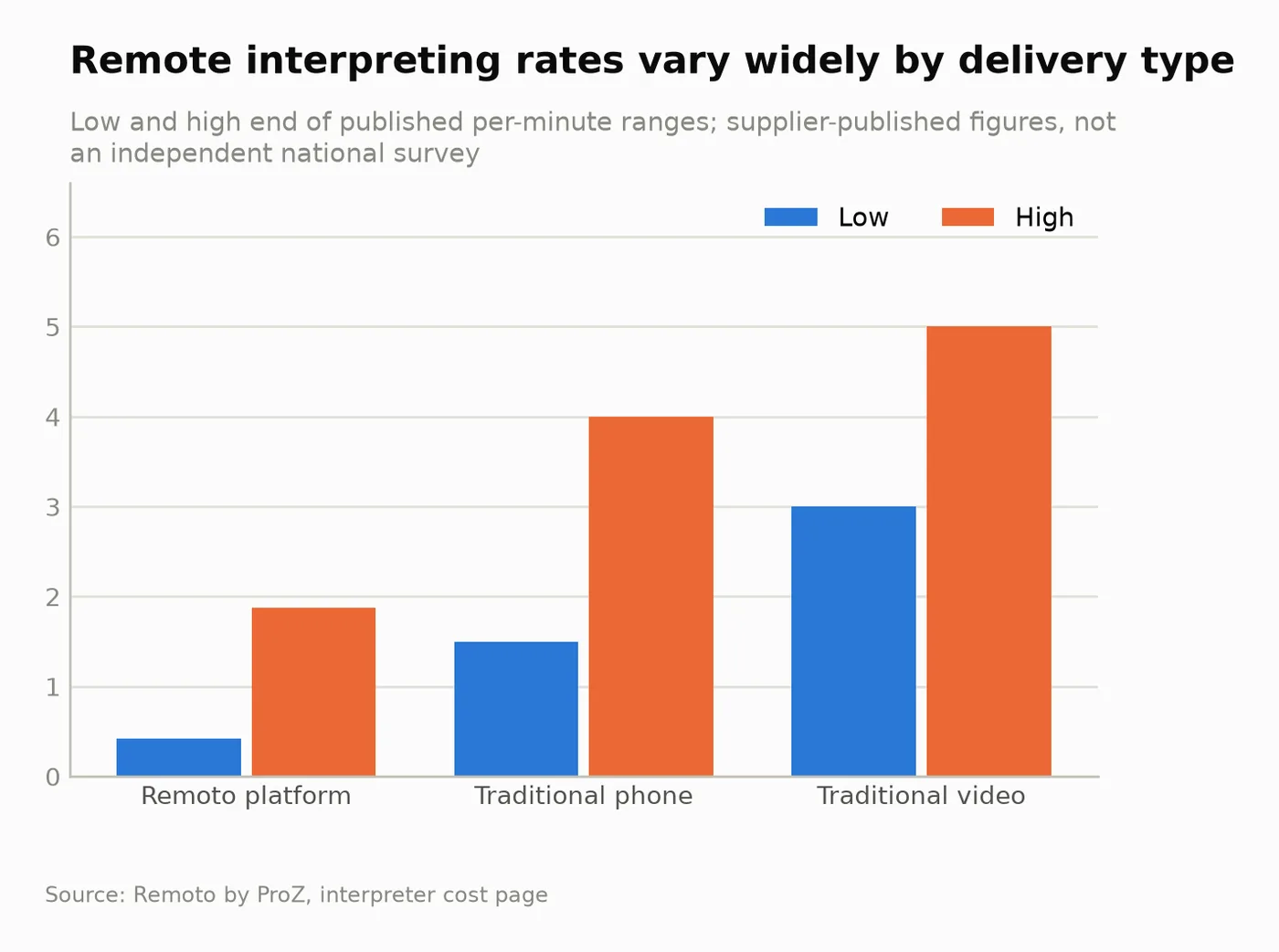
Per-minute remote interpreting rates in USD, as published by Remoto by ProZ
AI interpreting does the same job with speech models: it listens, translates and speaks the result, with captions alongside. The research is promising but specific. In the IWSLT 2025 evaluation, one English-to-Japanese system was judged comparable to a student interpreter and below a professional, with latency about three times lower than the human comparison, though the human worked without a booth partner or normal preparation. The ATA statement on artificial intelligence sees value for predictable, low-risk content and warns that fluent output can hide errors and that data handling can threaten confidentiality. Microsoft’s Teams Interpreter documentation flags names, genders, technical terms and overlapping dialogue as weak spots, and lists 10 languages.

Microsoft’s support page for the Interpreter agent in Teams meetings and calls
Palabra was built for the live, many-listener situations where AI fits best. It runs its own speech models end to end and speaks the translation in under a second, with captions, across 60+ languages. At an in-person or hybrid event, attendees scan a QR code, pick a language and listen on their own phones, with every selected language running at once and no booths. Audio and text are processed in memory and never stored or used for training, which addresses the data-handling concern. More on the category in our remote simultaneous interpretation articles.
Palabra’s blog: articles on translation and interpretation for live events
| Delivery | Delay | Cost model | Best for |
|---|---|---|---|
| Onsite | Consecutive turns, or a few words behind | Hourly or daily, plus travel | Legal, medical and high-stakes meetings |
| Phone (OPI) | Consecutive turns | Per minute | Short support and service calls |
| Video (VRI) | Consecutive or simultaneous | Per minute | Sign language, clinics, visual context |
| AI | Near real time, varies by product | Subscription hours or per minute | Events, webinars, streams, many languages at once |
What interpreters do and the skills they need
What do interpreters do? They spend as much time preparing as performing. A typical assignment means reading the agenda, slides or case file, building a glossary of names and terms, then interpreting while managing the flow, asking a speaker to pause or repeat when needed. The HHS guidance quoted earlier sums up the standard: interpreting effectively, accurately and impartially.

Four HHS key facts on healthcare interpreting: qualification, Section 1557 access, and free, accurate, timely language help.
In medical and legal settings, interpreters also sight-translate forms and flag when a concept has no direct equivalent, without adding advice of their own. The core skills:
- Fluency in both languages, including idiom, register and regional variants.
- Memory and note-taking, to hold long segments in consecutive work.
- Split attention, listening and speaking at once in simultaneous work.
- Cultural knowledge, for cross-cultural communication beyond the words.
- Ethics: confidentiality, impartiality and accuracy.
- Public speaking, a skill AIIC singles out for conference work.
- Work tools: booth consoles, headsets, remote platforms, terminology databases.
Becoming an interpreter and hiring one: career path and buyer guide
Two readers land here: people who want to do this work, and teams that need to buy it. BLS figures for the combined interpreters-and-translators occupation show a May 2025 median of $60,170 a year ($28.93 an hour), excluding self-employed workers. The occupation had about 73,900 jobs in 2025, with 2% projected growth to 2035 and roughly 6,000 openings a year.

Annual pay for US interpreters and translators, May 2025: the lowest 10% earn under $37,070, the median is $60,170, and the highest 10% earn over $103,660 (self-employed workers excluded).
For career-seekers: the path to becoming an interpreter
The route is concrete, and each step can be checked:
- Prove both languages. Certification bodies test proficiency in English and the service language, not just conversation.
- Get the education. BLS lists a bachelor’s degree as typical entry-level education. For healthcare, CCHI eligibility requires age 18+, a high-school diploma or equivalent and at least 40 hours of healthcare interpreter training. NBCMI’s prerequisites accept a 40-hour course or three college credit hours. A medical interpreting training school or college program covers this.
- Know certificate from certification. NCIHC separates a certificate of course completion from certification based on a valid assessment. A healthcare interpreting certificate from a 40-hour course does not make you certified.
- Pass a credential exam. CCHI’s knowledge exam comes first, then a performance exam (CHI in Arabic, Mandarin and Spanish). Its standalone CoreCHI credential is awarded only through December 31, 2026, and CCHI’s listed fees total $533 for the application, knowledge exam and one performance exam. NBCMI’s full CMI certification covers Spanish, Mandarin, Cantonese, Russian, Vietnamese and Korean. For courts, the federal certification exam is Spanish/English only, written then oral, and next given in 2027. ASL interpreters follow the RID credentials above.
- Get first experience. BLS notes that part-time work and variable schedules are common. Community, remote and phone assignments build hours.

US Courts page for the Federal Court Interpreter Certification Examination
Budget for exams separately from training, since the published fees cover testing only.
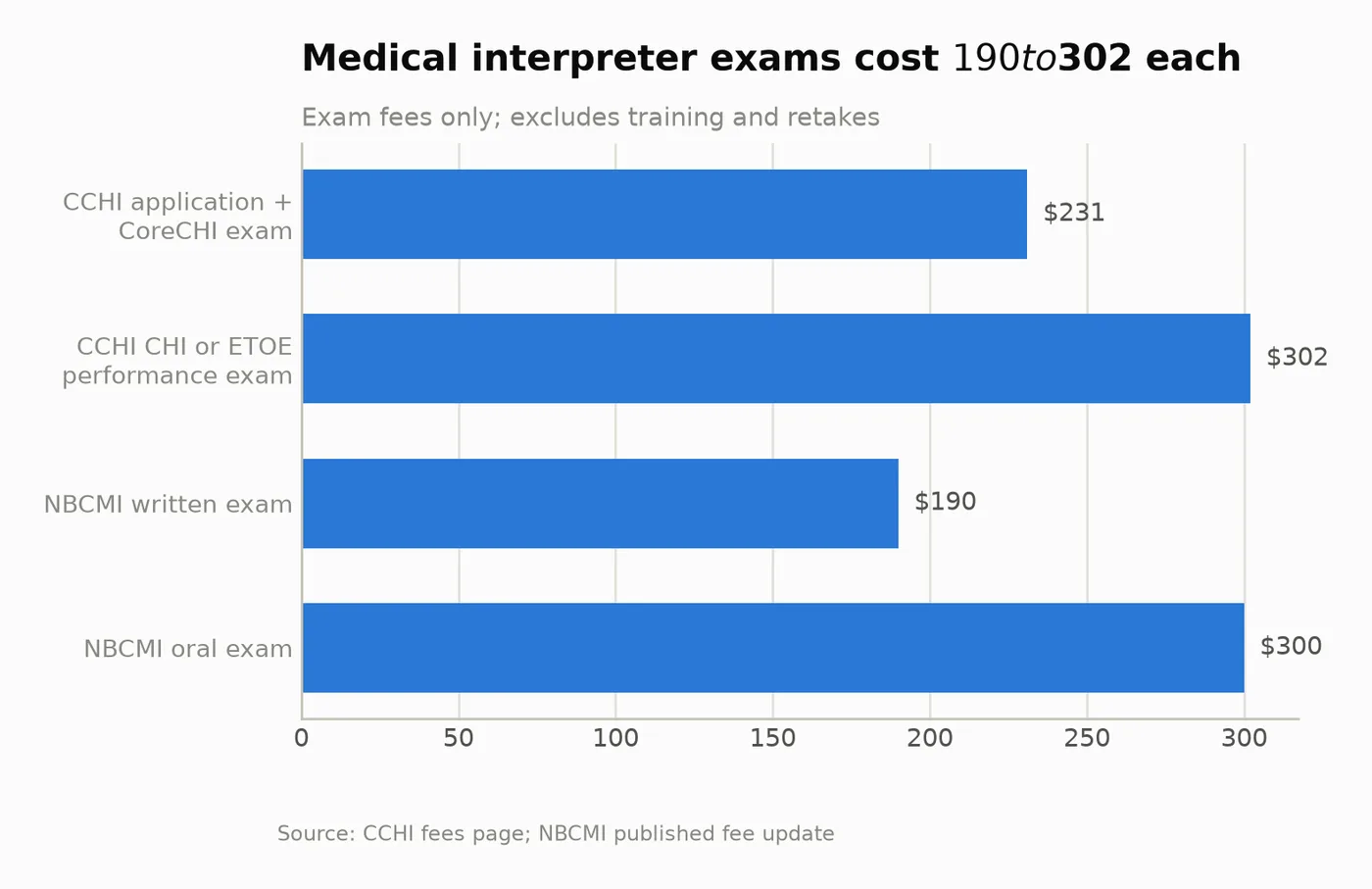
Published US medical interpreter exam fees (USD), excluding training and retakes, per CCHI and NBCMI
For business buyers: matching the interpreter to the job
For teams, the real question is which mode the scenario needs and how much is at stake. A workable rule: where law or safety requires a qualified interpreter, hire a human. Where you need many languages for a large audience at once, AI usually wins on reach and cost.
| Scenario | Recommended mode | Human or AI |
|---|---|---|
| Dallas convention keynote for a multilingual crowd | Simultaneous | AI for many languages at once; human booth for diplomatic sessions |
| NYC client presentation | Simultaneous, in the meeting | AI meeting bot |
| Inbound support calls | Consecutive, by phone | Human OPI, or AI built in through an API |
| Hospital or clinic visit | Consecutive, onsite or VRI | Qualified human interpreter |
| Los Angeles deposition | Consecutive plus sight translation | Certified human interpreter |
| Chicago court hearing with a deaf party | ASL, onsite or VRI | Human ASL interpreter |
| Training, webinars, livestreams | Simultaneous | AI |
Costs follow different models. Translators USA’s conference rates page gives indicative ranges of $1,200 to $2,500 per interpreter per day onsite and $900 to $2,200 remotely. Wordly’s pricing page lists about $1,500 for 10 hours of AI translation. Palabra’s events app starts at $500 a month for 5 hours with unlimited listeners per language. The meeting bot for Zoom, Google Meet and Microsoft Teams starts at $60 a month, and only the organizer needs a subscription. Teams building their own product can use the speech translation API at $0.04 per minute.

Palabra’s pricing page: the Starter, Pro, Team and Business plans with their prices and capacity
For webinars and broadcasts, live stream translation takes one feed from OBS, vMix or YouTube Live and returns translated audio and captions in the speaker’s cloned voice. Our guide to AI interpretation services for business goes deeper on choosing a partner. If your next event, meeting or stream needs several languages at once, try Palabra on it and judge the result with your own audience.