Translation vs interpretation at a glance
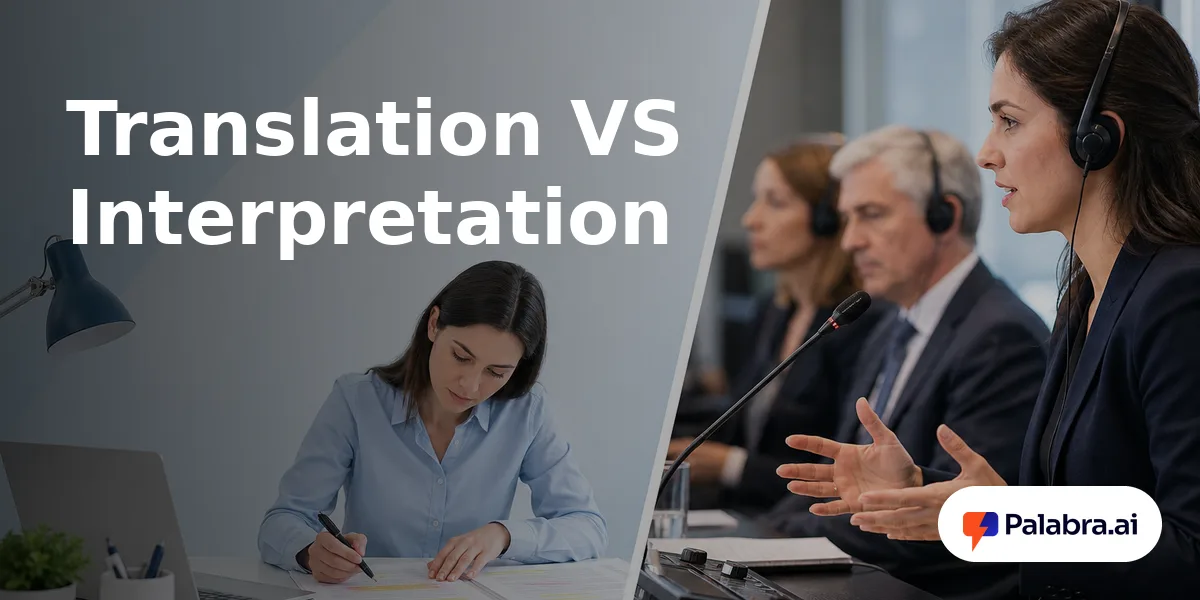
Translation vs interpretation comes down to the medium. Translation converts written text from one language into another. Interpretation converts spoken or signed language, live, while people communicate. The American Translators Association’s client guide sums it up: translators work with written text, interpreters with spoken language.
So is translation and interpretation the same? No. The two are related, but they are different professions with different skill sets, tools, credentials and pricing. Mixing up translator vs interpreter is one of the most common reasons buyers book the wrong service. A translated contract does nothing for a live negotiation, and an interpreter at a meeting does not leave you with a finished document.
| Translation | Interpretation | |
|---|---|---|
| Medium | Written word | Spoken or signed language |
| Output | A finished document, website, file or subtitle track | Live speech or signing for listeners |
| Timing | After the fact, against a deadline | In real time, or with short pauses |
The rest of this guide covers how each profession works and how they compare side by side. It then turns to pay, industry use cases, where machine translation and live AI interpretation fit, and a quick chooser for hiring.
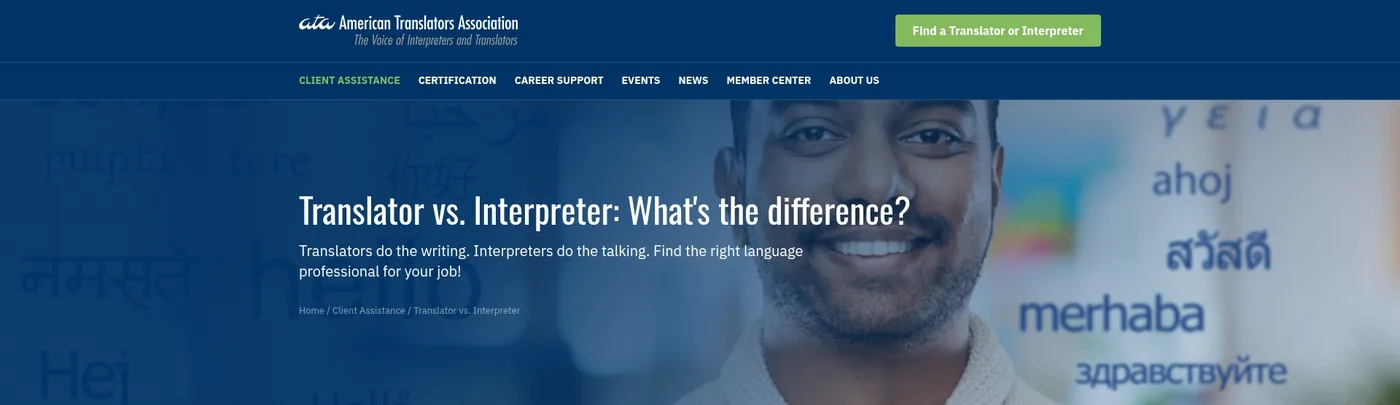
ATA’s client guide, ‘Translator vs. Interpreter: What’s the difference?’, opens by separating written translation from spoken interpretation
What translation is and how translators work
The definition of a translator is simple: someone who translates written content from a source language into a target language. That content can be contracts, manuals, medical forms, software strings, marketing copy or books. The work is asynchronous. The translator reads the full source text, researches terminology, drafts and revises. Often a second linguist reviews the text before delivery.
Translators usually work in one direction, into their native language, because writing natural prose is harder than reading it. Most specialize in a subject matter such as legal, medical, financial or technical content. ATA stresses that translation is more than word replacement. A good translator carries tone, intent, culture and dialect into the new language, not just vocabulary.
A typical workflow runs in four steps:
- Source text arrives with a brief: audience, purpose, deadline, glossary.
- Translation happens in a computer-assisted translation (CAT) tool. It surfaces earlier translated phrases from a translation memory and approved terms from a terminology database, as the US General Services Administration’s foreign language services guide describes.
- Review and editing by the translator, and often by a second reviewer.
- Target text is delivered in the required format.

Translation workflow: the source text goes to a translator, then through review, before it becomes the finished target text.
Fees follow the deliverable. ATA’s industry FAQ lists translation billing per word, per hour, per page or per project. Rates vary with the language pair, subject, deadline and market segment.
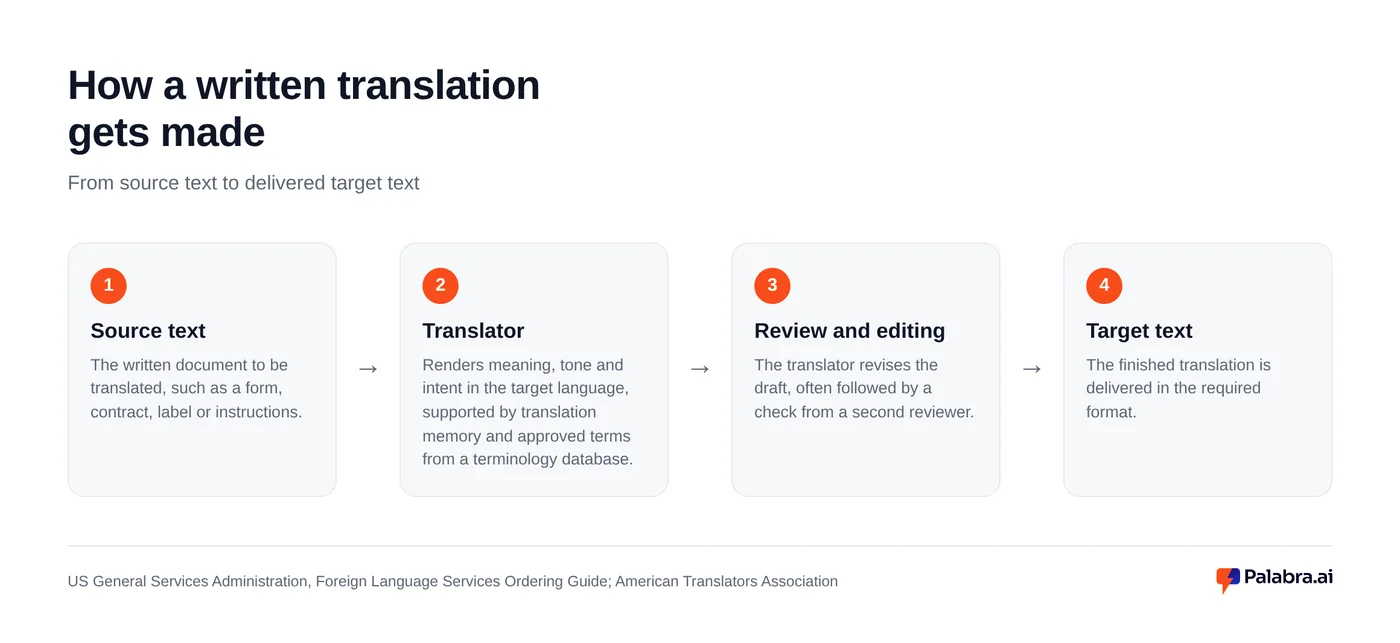
Written translation workflow: a source text passes to a translator, through review and editing, and is delivered as the finished target text.
Why are translators important? Written text outlives the moment. A mistranslated dosage instruction, warranty clause or safety label keeps causing harm every time someone reads it. The time a translator spends revising is part of what you pay for.
What interpretation is and how interpreters work
Interpretation renders spoken or signed language into another language while the conversation is happening. What is the role of the interpreter? To let people who speak different languages communicate as if the language barrier were not there, carrying meaning, tone and register both ways. Here is an interpreter example: a clinician and a patient, a judge and a witness, or a keynote speaker and a hall of listeners each hearing their own language. In everyday speech, people often use "translator" as an interpreter synonym. That habit is where much of the confusion starts.
Interpreters often work in both directions in the same session, switching languages turn by turn. They have no time to look anything up, so the job rests on listening, quick recall, analysis and clear delivery. The European Commission’s interpreting knowledge centre describes the core work in three steps. The interpreter listens actively, analyzes and structures the message, then reproduces it in the target language. Interpreters typically bill by time. ATA lists hourly, half-day, full-day and weekly or per-diem rates.
The main modes differ in timing, equipment and audience size, as the European Commission’s guide to conference interpreting sets out:
| Mode | How it works | Typical setting |
|---|---|---|
| Simultaneous | Interpreter speaks or signs while the speaker continues, usually from a booth with microphones and earphones | Conferences, summits, international meetings |
| Consecutive | Speaker pauses; interpreter delivers each segment afterward, often from notes | Interviews, appointments, turn-taking proceedings |
| Whispered (chuchotage) | Interpreter sits beside a few listeners and interprets simultaneously to them | Small delegations, a guest in a meeting |
| Relay | Interpreters work through a pivot language when no direct pair exists, such as Finnish to Slovak via French | Multilingual institutions |
| Remote | Interpreter joins by phone or video | Telehealth, courts, distributed teams |
| Sign language | Interpreter works between a signed language, such as American Sign Language, and a spoken one | Courts, classrooms, public services |
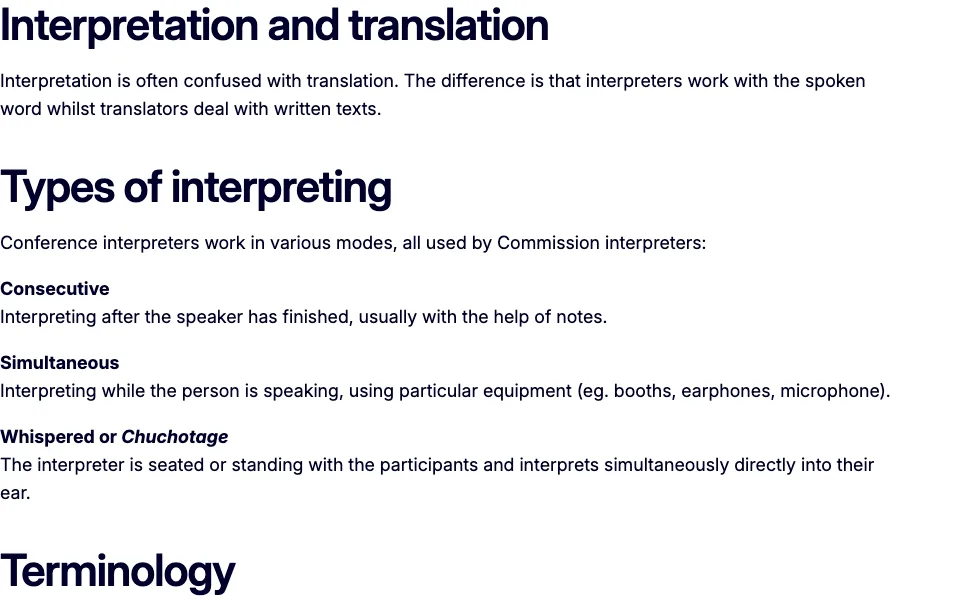
The European Commission’s conference-interpreting page explains consecutive, simultaneous and whispered interpreting.
The difference between simultaneous and consecutive interpretation comes down to time and equipment. Simultaneous interpreting keeps an event moving at full speed but traditionally needs booths and headsets. Consecutive needs no equipment but adds time, because every segment is delivered twice. Sign language is a language modality rather than a timing mode: it can be simultaneous or consecutive, on site or remote.
For a feel of both jobs, ATA’s short animated video, A Day in the Life of Translators and Interpreters, shows how each profession spends its working hours.
ATA’s animated video follows a working day for translators and interpreters
Key differences between translation and interpretation
The difference between translation and interpretation shows up in every practical dimension, from how work is checked to how it is billed. Even the vocabulary is formalized: ISO 20539:2023, a terminology standard, names translation and interpreting separately in its title. The table shows the difference between interpreter and translator work, side by side.
| Dimension | Translation | Interpretation |
|---|---|---|
| Medium | Written text | Spoken or signed language |
| Source and target handling | Full source text available before work starts | Source arrives live, segment by segment |
| Direction | Usually one direction, into the native language | Often both directions in one session |
| Timing | Asynchronous, against a deadline | Live, simultaneous or with short pauses |
| Revision | Drafted, edited and reviewed before delivery | One pass, corrected on the fly |
| Tools | CAT software, translation memory, glossaries | Booths, microphones, headsets, notes, remote platforms |
| Pricing basis | Per word, hour, page or project | Per hour, half-day, full-day or per diem |
| Typical use | Contracts, manuals, websites, subtitles, forms | Meetings, conferences, hearings, appointments, broadcasts |
So what is the difference between translating and interpreting in practice? Revision is the biggest one. A translator sees the whole document, can check every term and can aim for perfection over several passes. An interpreter often starts speaking before the speaker finishes a sentence. Success means faithful, immediate communication, not polished prose.

From input to output: translation produces a revised written document, while interpreting delivers live communication in one pass.
The second difference is what you keep at the end. Translation leaves an artifact you can file, publish or sign. Interpretation leaves a conversation that happened. If you also need a record, ask for captions, transcripts or a recording on top of the interpreting.
The third is direction. Because translators write into their native language, a project with five target languages usually means five translators. One interpreter may cover both sides of a two-way conversation in a single language pair. A conference with many languages, however, needs a team for each one.
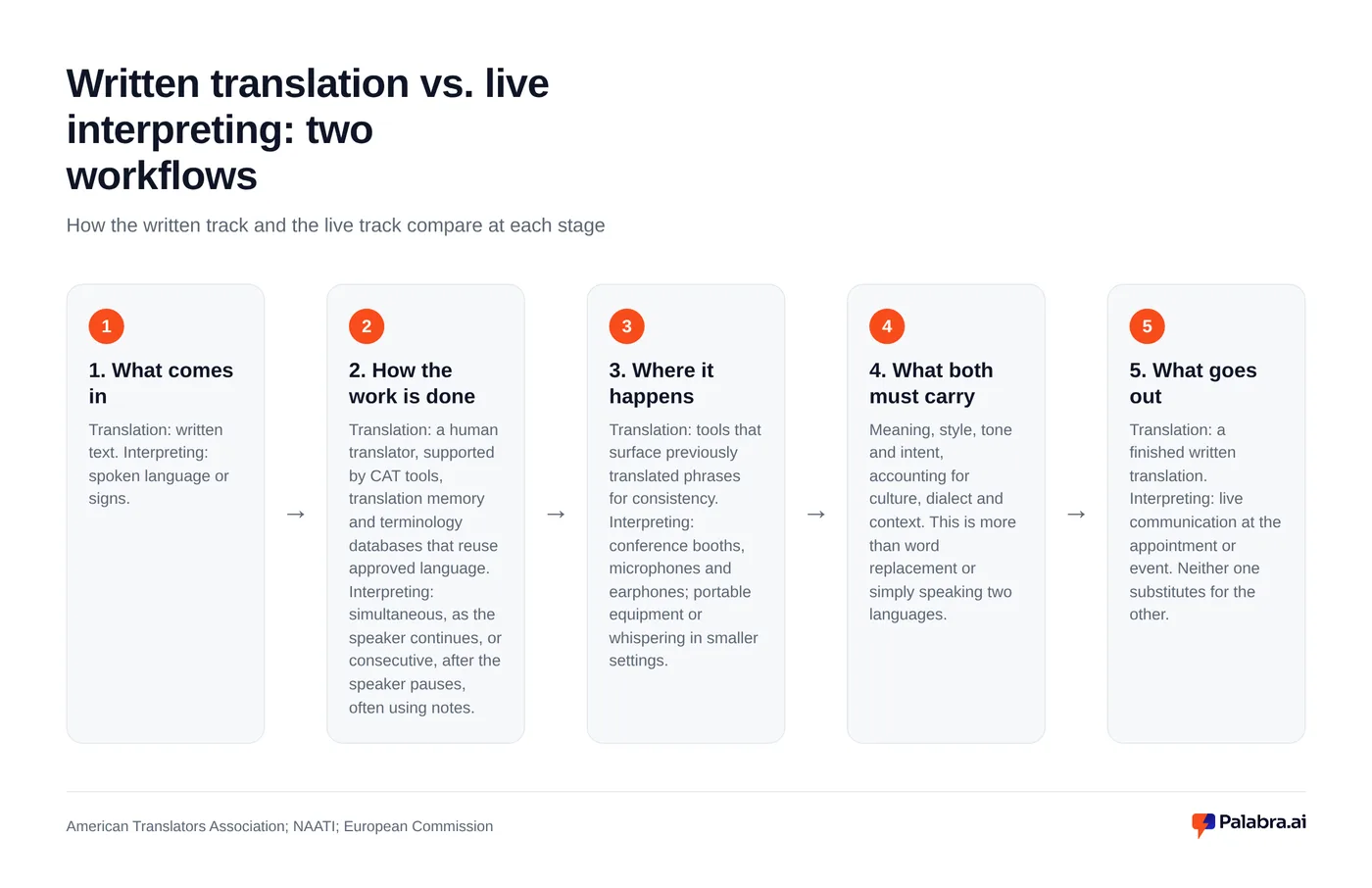
Written translation turns a text into a finished written translation, while interpreting carries spoken or signed language live, in simultaneous or consecutive mode.
Finally, the risk profile differs. A translation error can be caught in review before anyone sees it. An interpreting error reaches the listener instantly. That is why live settings such as courts and hospitals put so much weight on qualified interpreters, as the industry section below shows.
Skills, training, tools and pay
Both professions start from the same base. The US Bureau of Labor Statistics says workers need proficiency in English and at least one other language. They also need proficiency in the specific service they provide. Beyond that, the skill sets split.
| Translators | Interpreters |
|---|---|
| Excellent writing in the target language | Listening, short-term memory and clear spoken delivery |
| Research and terminology management | Instant recall and on-the-spot problem solving |
| CAT tools, translation memory, glossaries | Booths, headsets, note-taking, remote platforms |
| Credential: ATA certification | Credentials: federal court certification, medical interpreter credentials |
| Deadlines and desk-based, often remote work | Scheduled sessions, on site or remote |
Credentials are service-specific. ATA certification is a translator credential for specified language pairs, earned through a three-hour, open-book, proctored exam. Court interpreters in the federal system take the Federal Court Interpreter Certification Examination. It is offered for Spanish/English and has a written screening phase and an oral performance phase.
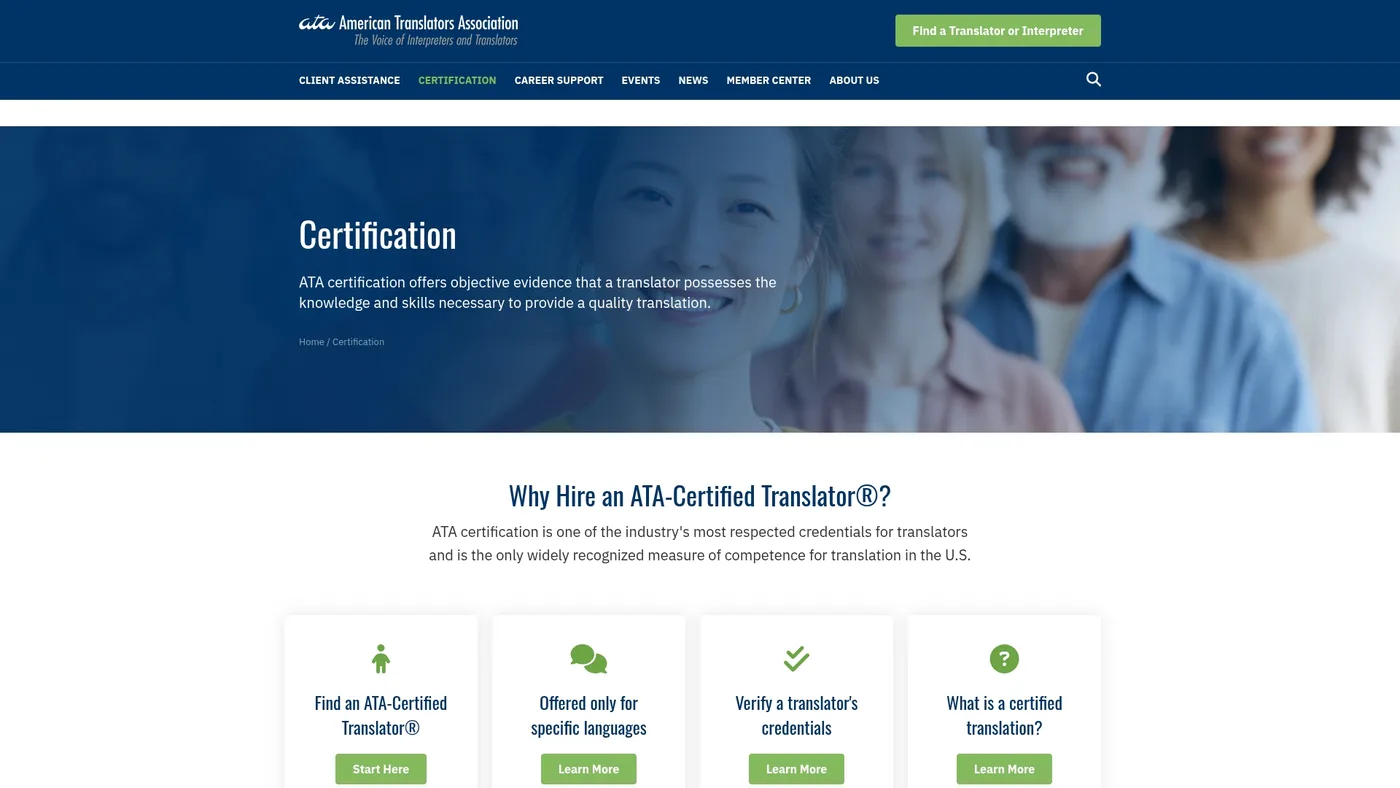
ATA certification is a translator credential offered for specified language pairs
Can the same person be both a translator and an interpreter? Yes, one person can hold both skill sets. Each still needs its own training and, in regulated settings, its own credential. Formal routes range from university degrees, including classical language studies, to specialist courses.
On interpreter vs translator salary, BLS reports one figure for the combined occupation. Treat it as the shared benchmark, including for questions like how much a medical interpreter makes.
| Measure | Figure |
|---|---|
| Median annual wage, May 2025 | $60,170 |
| Median hourly wage | $28.93 |
| Projected employment growth, 2025–2035 | 2% |
| Openings per year | About 6,000 |

BLS Occupational Outlook Handbook: pay and outlook for interpreters and translators
Where each service fits: use cases by industry
The choice is rarely interpretation services vs translation services: most organizations need both, for different moments. The table maps typical needs by sector. The notes below it cover the settings where rules apply.
| Industry | Typical translation need | Typical interpretation need | Certification or compliance note |
|---|---|---|---|
| Medical | Discharge instructions, consent forms, patient materials | Appointments, emergency care, telehealth | HHS rules call for qualified interpreters and translators in covered health programs; CCHI and NBCMI credential interpreters |
| Legal | Contracts, evidence, court filings | Hearings, depositions, client meetings | Federal court certification for Spanish/English |
| Events and conferences | Programs, slides, signage | Keynotes, panels, Q&A | — |
| Customer support | Help center articles, templates | Live calls and video support | — |
| Business meetings | Agendas, minutes, follow-ups | Negotiations, interviews, all-hands | — |
| Localization | Software, websites, apps, layout | — | — |
| Religious | Scripture, liturgy, study material | Sermons and services | — |
Medical interpreter vs medical translator. For a live clinical conversation, you need oral interpretation. For written materials, you need a qualified translator. HHS Title VI guidance asks funded providers to take reasonable steps toward meaningful access. It balances four factors, including how many people need help and how important the service is. The HHS Section 1557 language-access letter cautions that a bilingual person may not be qualified to interpret. Interpreters can earn credentials through CCHI, which requires at least 40 hours of training, or the NBCMI Certified Medical Interpreter credential. CCHI notes its CoreCHI credential will be discontinued from January 1, 2027.

Key HHS language-access facts: Title VI meaningful access, Section 1557 qualified interpreters and translators, and oral versus written services.
Legal interpretation vs translation. Court filings can require certified translation, so check the court’s rules. Hearings need interpreters, including remote sign-language interpreters. The New York State courts’ remote ASL guide shows the interpreter signing for a Deaf participant on a courtroom monitor and voicing the replies.
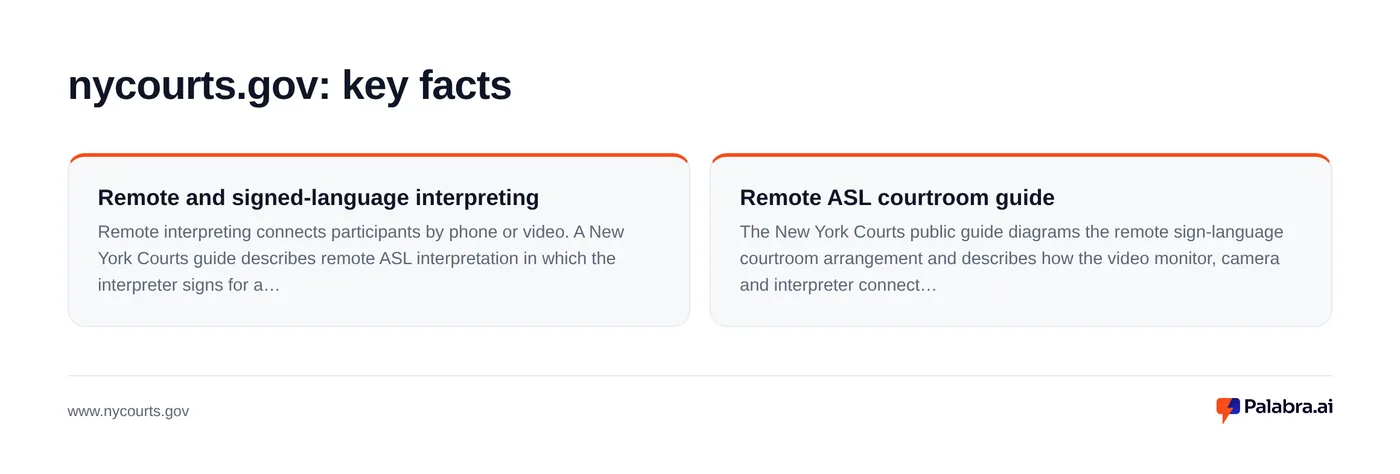
Key facts about nycourts.gov from its own pages
Localization and transcreation. GALA defines localization as adapting a product or service to a locale, with translation as one element alongside layout and design. For ads and slogans, ATA recommends transcreation, which recreates emotional impact rather than wording.

Key facts about gala-global.org from its own pages
Religious settings. People who search translation vs interpretation for the Bible usually mean scholarly written translation of scripture. A congregation that speaks different languages, on the other hand, needs live church service translation every Sunday.
Where AI and real-time technology fits
Artificial intelligence now covers both sides of the divide. Machine translation handles text. Live AI interpretation handles speech by chaining speech recognition, translation and speech synthesis fast enough for conversation. If you want the mechanics, see what real-time audio translation actually does and how translators cut latency.
The useful AI translation vs human interpretation question is about stakes, not about which is better overall. The evidence on text is mixed. A 2025 JAMA Network Open study of pediatric discharge instructions found that AI matched professional translation for Spanish but did worse for the other languages it tested. The gap was widest for Somali. NAATI advises against using AI for high-risk work, such as allergen lists, without supervision by a certified practitioner. It also lists ways AI can support interpreters, including terminology prep and live captions. HHS describes machine translation as an urgent stopgap in health programs while a qualified interpreter is found.

JAMA Network Open study comparing AI and professional translation of discharge instructions
For everyday multilingual meetings, webinars, events and streams, live AI is a strong fit. In many of these settings the realistic alternative is no interpretation at all. This is where Palabra works. Palabra runs its own speech models end to end, from recognition to synthesis, and speaks the translation in under a second, in 60+ languages.
| Human translator | Machine translation | Human interpreter | AI live interpretation (Palabra) | |
|---|---|---|---|---|
| Latency | Deadline-based | — | Live | Under 1 second |
| Languages | Per translator’s pairs | — | Per interpreter’s pairs | 60+ |
| Cost model | Per word, hour, page or project | — | Per hour, half-day, day | From $10/hour (meetings Team); API $0.04/minute |
| Best for | Legal, medical, published text | Gist, high-volume drafts | Courts, clinical care, high-stakes talks | Meetings, webinars, events, streams, apps |
| Limits | Time | Varies by language | Availability, cost | Specialist terms need a glossary |
For online meetings, Palabra’s bot joins a Zoom, Google Meet or Microsoft Teams call and translates speech as audio and captions. Only the organizer needs a subscription, and attendees need no app. The Pro plan costs $150 a month for 10 hours, and the same setup powers webinar translation where every viewer picks a language.
Built-in options exist too. Microsoft’s Teams Interpreter help page lists a bounded language set. It notes that rapid exchanges, names and technical terms can be difficult.

Palabra meetings plans, effective price per included hour in US dollars (monthly billing: $60/3h, $150/10h, $500/50h)
For broadcasters, live stream translation takes a feed from OBS, vMix or any SRT/RTMP pipeline and outputs translated audio in the speaker’s cloned voice. Developers can build on the speech-to-speech API at $0.04 per minute, with $50 in free credits. On data, by default Palabra does not store audio and text and does not use them for training. Content may be cached briefly, for up to a minute, and is stored when you turn on recording or voice cloning. Palabra offers GDPR compliance (as a data processor), HIPAA compliance and ISO 27001 certified infrastructure.

Microsoft’s help page for Interpreter in Teams meetings and calls
How to decide which service to hire
Most hiring mistakes happen before anyone looks at a price. Work through these steps in order and the right service usually becomes obvious.
- Written or spoken? Written means translation; spoken or signed means interpretation.
- Live or asynchronous? Live speech needs an interpreter or live AI. Recorded media can be transcribed and translated later.
- One-way or two-way? A keynote is one-way. A negotiation or Q&A is two-way and needs both directions covered.
- What are the stakes? Court, clinical and safety-critical work calls for certified humans, with AI in a support role at most.
- What is the budget and scale? For recurring meetings and multilingual events, live AI makes interpretation affordable at volume.

Five questions, in order, for deciding between translation, human interpretation and live AI
Before you book, answer these questions:
- Which languages, and how many at once?
- How many listeners, on site or remote?
- Does a law, court or funder require certified or qualified professionals?
- Do you need a transcript, captions or a recording afterward?
- Do you have a glossary of names and technical terms?
For conferences, Palabra’s events app replaces booths and headsets. The organizer connects the audio source, and attendees scan a QR code to listen on their own phones. Setup takes under 2 minutes, with unlimited listeners per language. The app also detects the input language itself; see how language detection from audio works.
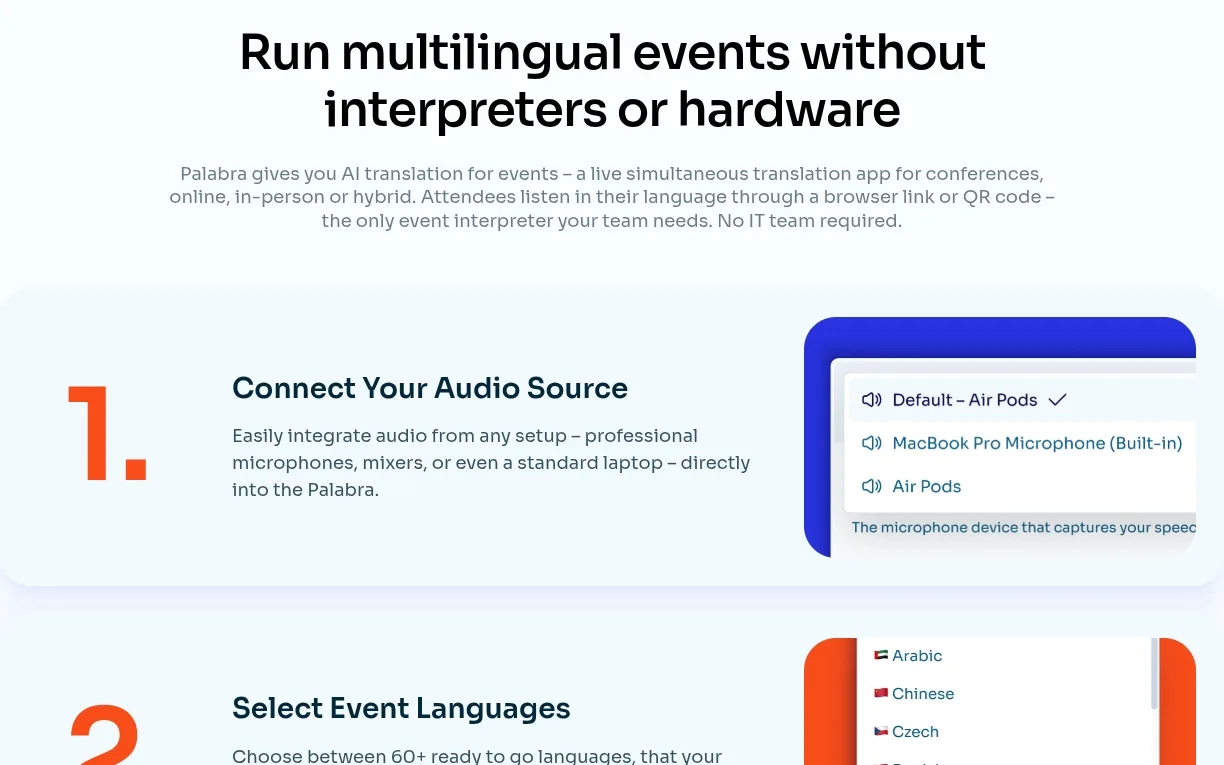
Palabra’s in-person events solution: attendees scan a QR code and listen in their language
Common misconceptions that lead to the wrong purchase:
- "A bilingual employee can interpret." Fluency is not the same as being qualified, especially in healthcare.
- "Translators and interpreters are interchangeable." A translated form will not help at a live appointment.
- "Machine translation is equally good in every language." Quality varies by language pair and subject.
- "Live interpretation needs booths." For meetings, webinars and many events, live AI on attendees’ own devices covers it.
To compare more tools, read our guide to language translation tools. If live speech is your use case, talk to the Palabra team and see it working in your own meeting or event.