What consecutive interpretation is
What is consecutive interpretation? It turns speech into another language one turn at a time. The speaker talks and then stops. The interpreter then delivers the same message in the target language. Nobody talks over anyone: listeners hear the original first and the interpretation second.
The European Commission’s interpreting service gives a clear definition of consecutive interpreting. A speaker delivers a speech or several sentences while the interpreter takes notes. The interpreter then reproduces the message for the audience in another language. Everything else about the practice follows from that sequence.
A consecutive interpreter is the professional in the middle of that exchange. They listen to a full segment, hold its meaning in memory and notes, and re-express it in another language. The job is not word-for-word substitution. The interpreter has to accurately convey meaning, tone and intent, and in a dialogue they do it in both directions.
You will also see the phrase "consecutive translation", especially on agency websites. Strictly, the professions use two different words. The US Bureau of Labor Statistics separates interpreters, who work with spoken or signed language, from translators, who convert written material. So the answer to "what is consecutive translation?" is the same as the answer to "what is consecutive interpreting?": in everyday use, both mean spoken language rendered in turns.
The wording matters when you buy. If you are writing a procurement brief or a contract, "consecutive interpreting" is the precise term and avoids confusion with document translation. If you are just searching for help, either phrase will find it. The American Translators Association, the US professional body for translators and interpreters, is a common starting point when you are looking for a qualified practitioner.
How the consecutive interpreting process works
Consecutive interpreting is a straightforward process built around a loop. It repeats until the meeting ends, and its rhythm is set by how long the speaker talks before pausing.
- The speaker talks in a segment. The segment might be one sentence or several minutes of a speech.
- The interpreter listens and takes notes. The notes capture ideas, numbers, names and the logic connecting them, not every word.
- The speaker pauses. This hands the floor to the interpreter.
- The interpreter delivers the message in the target language. They rebuild the segment from memory and notes, usually speaking to the same audience from the same spot.
- The next segment begins. In a speech, the speaker continues. In a conversation, the other party replies, and the loop runs in the opposite direction.
| Speaker | Pause | Notes | Delivery |
|---|---|---|---|
| Talks in the source language | Stops at a natural break | Interpreter finalizes notes and plans the rendering | Interpreter speaks in the target language |
There is no universal segment length. A 2026 peer-reviewed study describes short consecutive as a sentence or brief idea unit, sometimes handled without notes. The same paper describes long conference consecutive passages of 5–10 minutes, citing AIIC for passages of up to about 15 minutes. Those are descriptive ranges from conference work, not a target for a medical visit or a courtroom exchange.
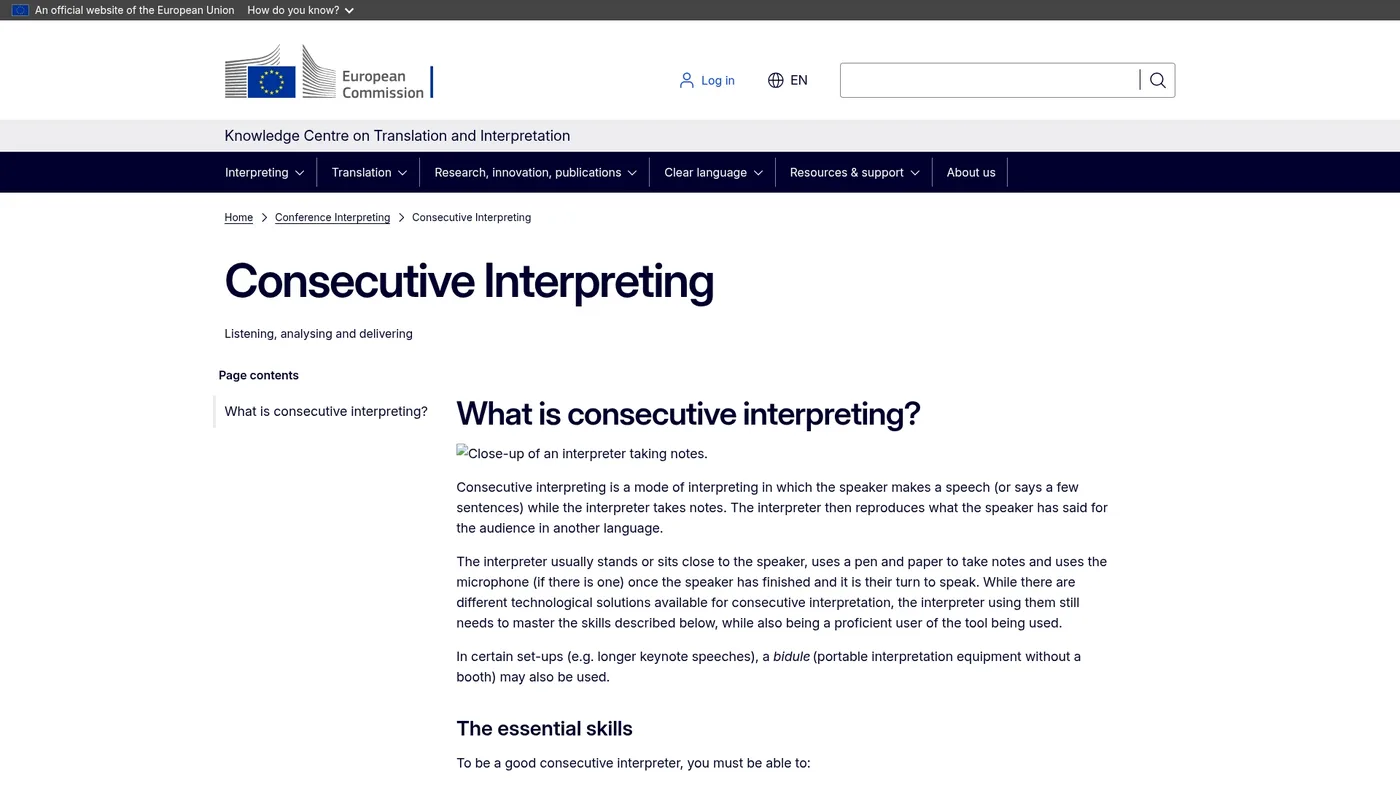
The European Commission’s training page on consecutive interpreting: listen, take notes, then deliver.
Two-way exchanges work differently from speeches. In a doctor’s appointment or a negotiation, the interpreter switches language direction at every turn and segments are usually short, a few sentences at most. That keeps the conversation moving and lowers the memory load on everyone.
Note-taking and core skills interpreters rely on
Consecutive work looks simple from the outside. In practice it combines several skills that interpreters train for years:
- Active listening: analyzing the message while it is still being spoken.
- Memory: holding the structure of a long segment in mind.
- Note-taking: a personal system of abbreviations and symbols.
- Language and cultural proficiency: knowing how an idea is naturally expressed in the target language and culture.
- Quick decisions: choosing a rendering in seconds, with no chance to revise.
Consecutive note-taking is a memory aid, not a transcript. Training slides hosted by the International Medical Interpreters Association teach Rozan’s seven principles: note ideas rather than words, abbreviate, mark links, mark negation, mark emphasis, write vertically, and shift items across the page. Interpreters lay notes out diagonally (subject, verb, object) and stack related information in parallel.
Symbols do much of the work. The same material teaches arrows as reusable concepts: ↗ for an increase, ↘ for a decrease, ↔ for an exchange, → for a consequence, plus a square for a country or state. The advice is blunt: build symbols beforehand, keep them consistent, and "don’t improvise mid speech".
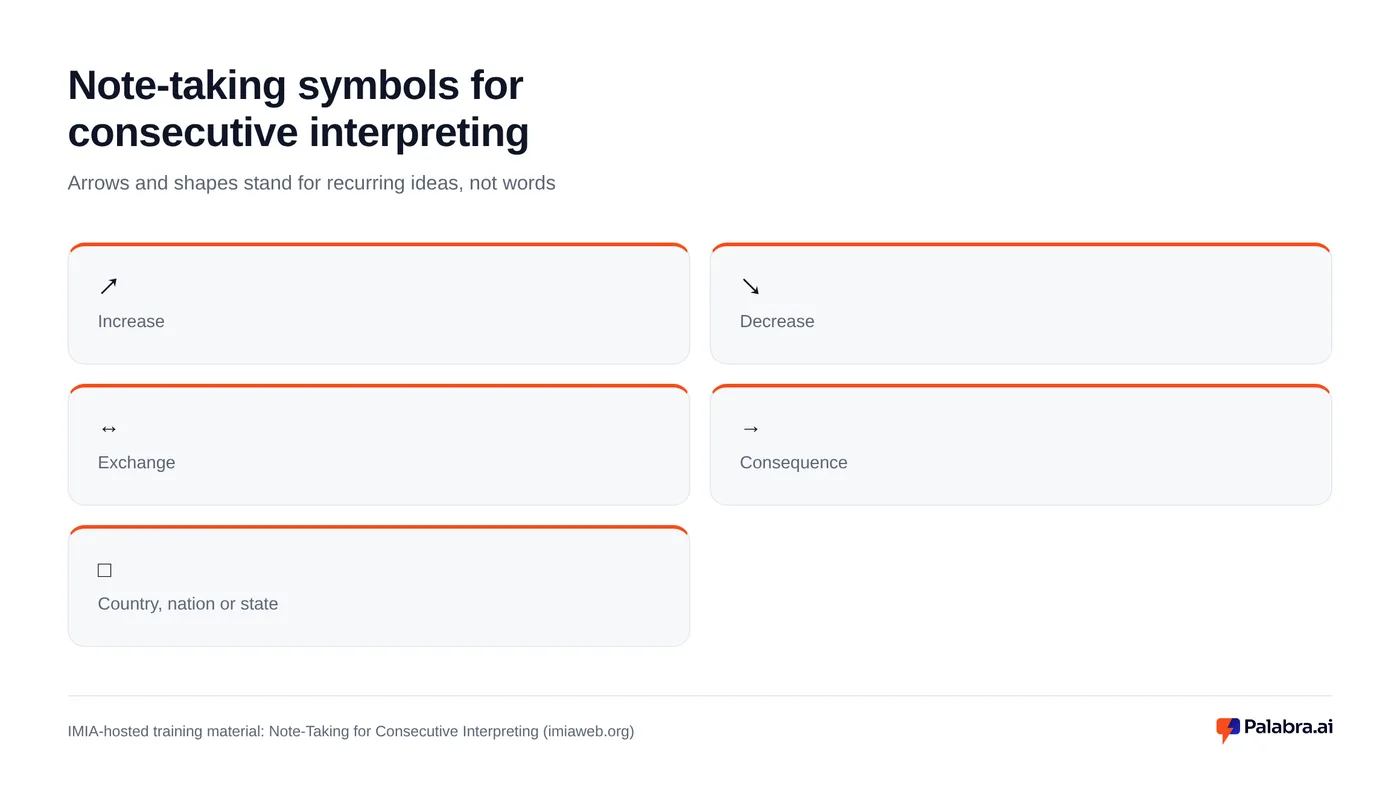
Example note-taking symbols for consecutive interpreting: ↗ increase, ↘ decrease, ↔ exchange, → consequence and a square for country, from IMIA-hosted training material.
Interpreters who want to improve their consecutive skills often start where the European Commission’s training does. Beginners first learn to reproduce speeches with no notes at all, and note-taking comes only once active listening and recall are solid. Remember first, write second.
Where consecutive interpretation is used
Consecutive interpretation fits settings such as medical consultations, where people talk in turns anyway, the group is small, and precision matters more than speed.
- Medical appointments: The National Council on Interpreting in Health Care says in its 2024 guidance that qualified healthcare interpreters primarily use consecutive. ASHA notes that consecutive is used more during spoken-language assessments and interventions, and advises frequent pauses.
- Legal proceedings and depositions: In US proceedings instituted by the United States, 28 USC §1827 specifies consecutive interpreting for witnesses, unless the judge authorizes otherwise. State courts and private legal depositions follow their own rules.
- Business meetings: AIIC lists bilateral negotiations and welcome or official speeches as typical consecutive settings.
- Small conferences: a keynote at a dinner, a press briefing, or a panel with one foreign guest.
Consecutive interpretation services are usually booked by the hour or by the half day through an agency or a freelance interpreter. Languages Unlimited’s 2026 conference pricing guide estimates $75–$150 per hour for consecutive interpreting in common pairs such as English–Spanish or English–French. The same guide warns about minimum bookings, often a half day even for a short session. Rates move with the language pair, subject specialization, experience and location, so a rare language pair or a technical medical session will cost more. For a fuller budgeting framework, see our guide to translation cost versus translator cost.
Government fees offer a public benchmark. From October 1, 2026, the federal court interpreter schedule pays certified interpreters $617 for a full day and $349 for a half day. These are contract rates for court work and do not price consecutive and simultaneous separately.
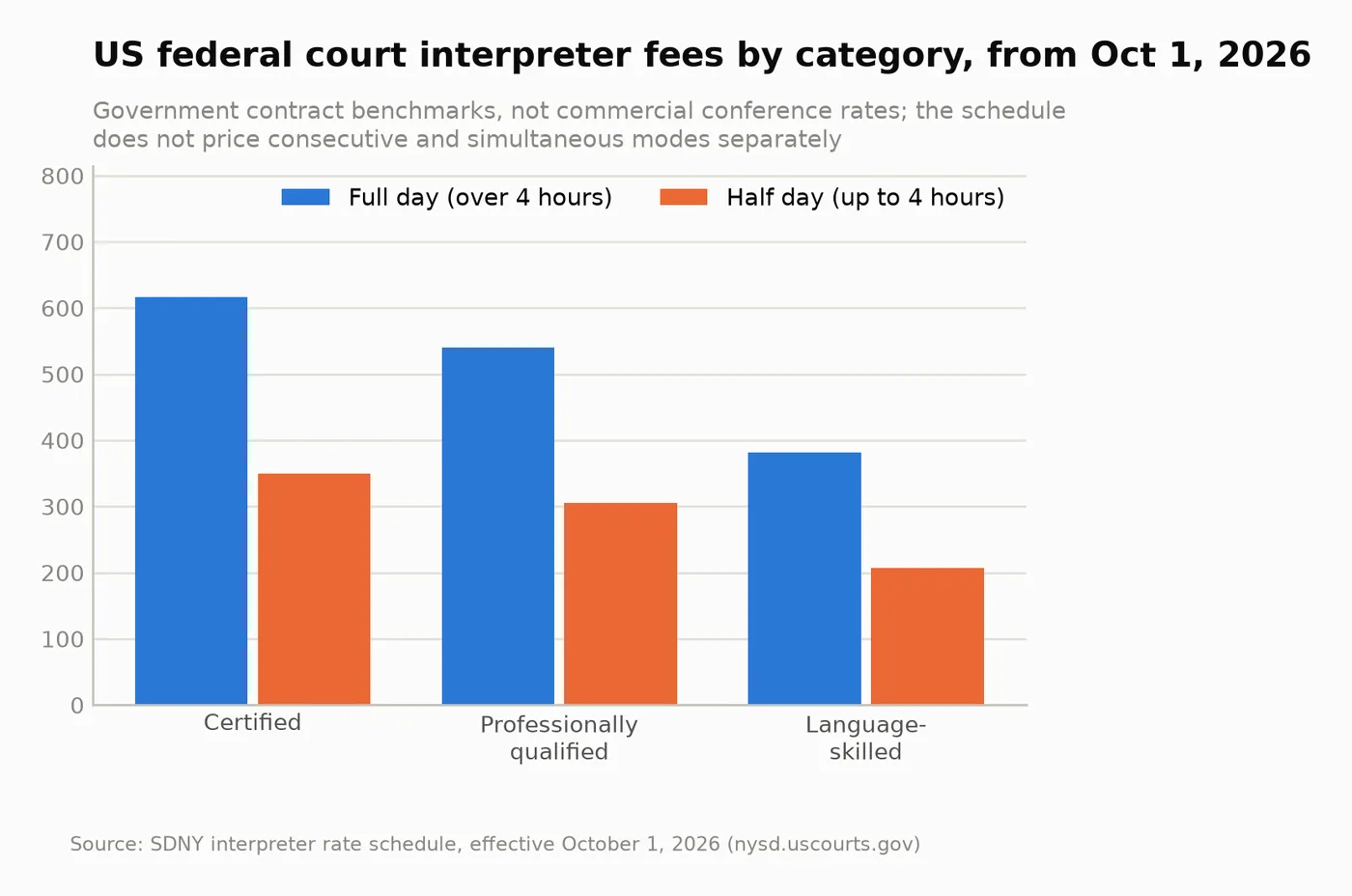
US federal court interpreter fees effective October 1, 2026, by interpreter category (source: SDNY interpreter rate schedule).
Consecutive vs simultaneous interpretation
What is simultaneous interpretation, often called simultaneous translation? It is the other main mode. A simultaneous interpreter speaks the translation while the speaker is still talking, typically from a soundproof booth. The audience listens on headsets. There are no pauses, so the meeting runs at its normal pace.
That speed has a cost in staffing. AIIC describes teams of two interpreters relieving each other every 20–30 minutes, and recommends allowing two to three interpreters per active language for a conference. On-site simultaneous work needs booths, a direct sound feed and simultaneous interpreting equipment for listeners. One exception is whispered simultaneous (chuchotage), where the interpreter sits beside one or two listeners and murmurs the translation with no booth at all.
Here is simultaneous vs consecutive interpretation, side by side.
| Consecutive | Simultaneous | |
|---|---|---|
| Timing | After the speaker pauses | While the speaker talks |
| Equipment | The speaker’s microphone setup; pen and paper | Booths, sound feed, headsets (except whispered) |
| Typical setting | Interviews, appointments, negotiations, speeches | Multilingual conferences, assemblies, broadcasts |
| Cost | Usually one interpreter, often with a half-day minimum | Freeland lists $80–$200 per hour as interpreter earnings, not a complete customer price |
| Accuracy | Interpreter hears the full segment before rendering and can restructure it | Interpreter commits before the sentence ends; relies on anticipation and team support |
| Meeting time | About twice as long, per AIIC | Runs in real time |
The time difference is the one that shapes most budgets. AIIC’s rule of thumb is that consecutive interpreting needs about twice as much time as simultaneous. A one-hour agenda becomes roughly two hours. That is a planning allowance, not a measured constant, but it is close enough to schedule against.

The AIIC Switzerland FAQ question list
Choosing between simultaneous and consecutive interpretation is rarely about which mode is "better". It depends on group size, how many languages are in the room, and whether the meeting can afford the extra time. Our walkthrough of AI simultaneous interpretation covers the simultaneous side in more depth. For events specifically, our analysis of professional interpreters versus AI platforms compares staffing and cost.
Challenges and limits of consecutive mode
Consecutive mode is precise, but it has real trade-offs that buyers and speakers should plan for:
- Longer meetings. The doubled meeting time described above cuts into agendas, and the speaker gets about half the airtime.
- Memory load. The interpreter carries every figure, name and argument until the pause comes.
- Loss of flow. Jokes, rhetorical build-up and energy flatten when the speech stops every few sentences.
- Long segments. A speaker who forgets to pause forces the interpreter to compress or drop detail.
- Fatigue. Hours of intense listening and recall wear down concentration, especially without breaks.
- Dependence on one person. Quality rests almost entirely on the skill, preparation and subject knowledge of the individual interpreter.
Most of these can be managed with a briefing before the session: share the agenda, names and terminology, and agree on when the speaker will pause. They can’t be removed entirely, because they come from the turn-taking itself.
Remote and AI-assisted interpretation, and choosing the right mode
Remote consecutive interpretation services keep the same pause-and-render sequence over a video call or phone line. The interpreter simply joins remotely. AIIC stresses that remote interpreters need high-quality sound and an excellent view of the speaker. Poor audio can disrupt remote interpretation.
Remote simultaneous interpretation works with parallel audio channels instead. In Zoom, the host designates language interpreters who each broadcast their own channel, and listeners pick a language. Interpretation has to be enabled for a scheduled meeting, and phone dial-in users cannot hear the channels.

Zoom’s language interpretation support article lists the requirements for using Language Interpretation in a meeting or webinar.
AI speech translation removes the turn-taking. Palabra listens to live speech and speaks the translation in under a second, with live captions alongside. For calls, an AI bot joins Zoom, Google Meet or Microsoft Teams. In conversation mode each participant speaks their own language and hears the others in theirs. Only the organizer needs a subscription, starting at $60 a month for 3 hours. Across 60+ languages, audio and text are never stored.

For conferences, Palabra’s AI translation for events lets attendees scan a QR code and listen on their own phones, with no booths. Developers can add the same pipeline to their own product through the speech-to-speech API at $0.04 per minute. In healthcare, NCIHC asks organizations to keep a protocol for switching to a human interpreter mid-session.
| Scenario | Best mode | Why |
|---|---|---|
| Doctor–patient appointment | Human consecutive | Healthcare guidance favors it, with a clear escalation path |
| Witness testimony | Human consecutive | Specified for witnesses in covered federal proceedings |
| Bilateral negotiation | Consecutive or AI two-way meeting translation | Turn-based talk; AI cuts the waiting time |
| Recurring client or team calls | AI meeting translation | Real-time pace, no interpreter booking |
| Multilingual conference | Simultaneous, human or AI | Many languages at once at full speed |
| Classes and parent meetings | AI interpretation for schools and universities | Every family hears its own language |
If your situation leans toward real-time speech translation, try Palabra on your next call and hear how it handles the conversation.